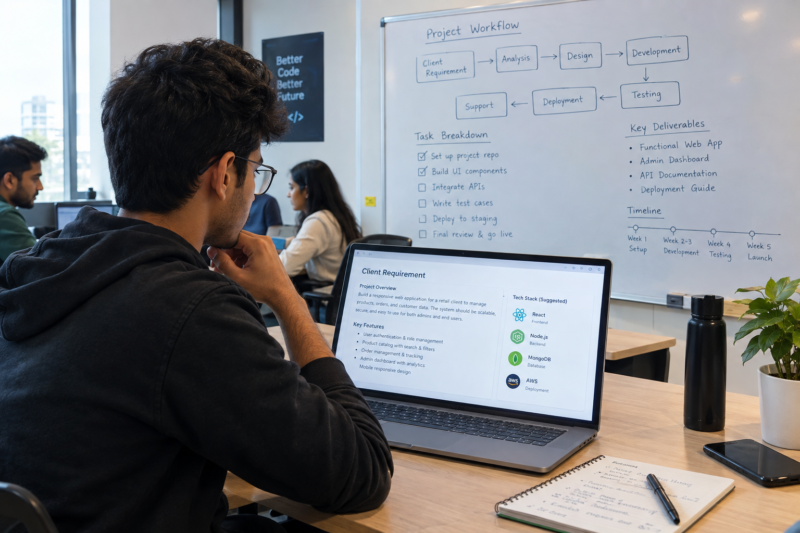
In a real IT job, clients do not always explain their needs clearly. Instead, they often use simple business language. For example, a client may say, “Our website is slow,” “We need an app,” or “Please add online booking.”
At first, these requests may sound easy. However, each one can hide many questions. Therefore, students need more than coding skills. They must also learn how to understand a problem before building a solution.
This is why the Best software Training Institute in Hadapsar should teach students how to turn a simple client request into a clear technical task.
Why Are Client Requests Often Unclear?
Clients know their business very well. However, they may not know how to explain their needs in technical terms.
Developers have the opposite problem. They understand technology, but they may not fully understand the client’s business.
Therefore, both sides need to communicate clearly.
For example, a restaurant owner may say:
“I want customers to book tables online.”
That sounds simple. However, several questions come next.
- Who can make a booking?
- What details should customers enter?
- Can they select a date?
- Can they select a time?
- How many tables are available?
- What happens when every table is booked?
- Will customers get a confirmation?
- Can staff cancel a booking?
As a result, the first step is not coding. Instead, the first step is asking the right questions.
What Is Requirement Translation?
Requirement translation means turning a business request into clear work for a technical team.
In simple terms, the process looks like this:
Business request → Questions → Clear requirements → Technical tasks → Development
For example, imagine a client says:
“Make our website faster.”
A student should not start changing the code right away. Instead, the student should first ask a few simple questions.
- Which pages are slow?
- Is the problem on mobile?
- Is the problem also on desktop?
- When did the problem start?
- Are large images causing delays?
- Are plugins slowing the website?
- What speed does the client expect?
Once these questions have answers, the request becomes clearer.
Consequently, the student can create specific tasks instead of making guesses.
Can the Best software Training Institute in Hadapsar Teach This Skill?
Yes. Practical software training should cover more than programming languages.
Students should also learn how software work begins. Usually, it begins with a problem, a user or a business need.
For example, students could receive this request:
“Our company needs an employee leave system.”
Instead of writing code immediately, students can break the request into smaller parts.
First, Identify the Users
The system may have employees, managers and administrators.
Each user may have different needs. Therefore, each user should be considered separately.
Next, Identify the Actions
Employees may submit leave requests. Managers may approve or reject them. Administrators may manage employee records.
As a result, the student can start seeing the full process.
Then, Identify the Information
The system may need employee names, leave types, dates and leave balances.
It may also need approval details. Therefore, students should think about the information before thinking about the database.
After That, Understand the Process
An employee submits a request. Next, the manager checks it. Then, the manager approves or rejects it. Finally, the system updates the leave balance.
This simple flow gives the student a much clearer picture.
Finally, Create Technical Tasks
Now the student can think about screens, databases, user access, validation and notifications.
As a result, development becomes easier to plan.
Why Should Students Ask Questions Before Coding?
Coding immediately may feel productive. However, it can create problems later.
Imagine a student spends two days building a booking system. Later, the client says that customers must also be able to change their bookings.
Now the student has more work.
The database may need changes. The booking screen may need changes too. In addition, the booking rules may need to change.
Therefore, asking questions at the beginning can save time later.
More importantly, it reduces the chance of building the wrong thing.
What Questions Should Students Ask First?
Students can use a simple question list before starting technical work.
1. What problem are we solving?
First, understand the real problem.
Do not focus only on the feature. Instead, find out what the client wants to achieve.
2. Who will use it?
Next, identify the users.
For example, a customer and an administrator may need very different features.
3. What should happen from start to finish?
Then, understand the full user journey.
This step can reveal missing actions. It can also reveal possible problems.
4. What should the final result be?
Now define success.
For example, a booking should only be confirmed when the selected time is available.
5. What limits should we consider?
Finally, look at the limits.
Budget, time, security, devices and existing software can all affect the final solution.
Therefore, students should look at the complete situation before choosing a technical approach.
Can One Simple Request Become Many Technical Tasks?
Yes. In fact, this happens often in real software work.
Consider this request:
“Add a login system to our website.”
A beginner may think:
“I only need to create a login page.”
However, there is much more to consider.
The student may need to:
- Create the login screen.
- Accept an email and password.
- Check the entered details.
- Verify the user.
- Show an error when details are wrong.
- Protect private pages.
- Add logout.
- Add password recovery.
- Set user permissions when needed.
Now the original request is much clearer.
As a result, the student can plan the work in smaller steps.
Why Is This Skill Useful in Job Interviews?
Technical interviews are not always about writing code.
Sometimes, an interviewer gives a problem and asks the candidate to explain the approach.
In that situation, jumping straight to a programming language may not help.
Instead, a student can first ask:
“Who will use the system?”
“What information will it handle?”
“What result should the system produce?”
These questions show that the student is trying to understand the problem first.
After that, the student can explain the technology they would use.
Therefore, requirement thinking can also help students communicate during interviews.
How Can IT Students Practise This Skill?
Students do not need a real client to practise.
Instead, they can use simple business requests from everyday life.
For example:
Business request:
“We need an online appointment system.”
The student can then:
- Identify the users.
- Understand the booking process.
- List the required information.
- Find possible problems.
- Define a successful booking.
- Break the work into smaller tasks.
- Consider suitable technology.
Similarly, students can practise with other examples.
- Restaurant booking systems
- E-commerce websites
- School management systems
- Employee attendance systems
- Customer support portals
- Fitness applications
- Inventory systems
This exercise is simple. However, it can teach an important habit: understand first, build second.
Why Does Requirement Thinking Matter in 2026?
Technology changes quickly. New tools appear every year. AI can also help developers create code much faster.
However, tools cannot replace a clear understanding of the problem.
For example, AI may generate a login system in seconds. But who decides what type of login the business needs?
Who decides which users should have access?
Who decides what should happen when a user forgets a password?
Therefore, students still need strong thinking and communication skills.
Instead of asking only:
“What code should I write?”
students should also ask:
“What problem am I trying to solve?”
That change can make technical learning more useful.
Moreover, structured requirements help teams connect user needs with development work. Students can learn more about this idea through Atlassian’s guide to user stories.
How Can Training Institutes Make Learning More Practical?
Traditional lessons can teach important concepts. However, students also need chances to use those concepts.
For example, a training class can give students a simple workplace situation.
Scenario:
“A company wants an employee attendance system.”
Students can then:
- Ask questions about the request.
- Identify the users.
- Understand the process.
- Write simple requirements.
- Break the work into smaller tasks.
- Explain their technical choices.
As a result, students practise the type of thinking they may need at work.
At Floating Minds Institute, practical learning can help students connect technical concepts with real workplace situations.
Can This Skill Help Students Feel More Confident?
Yes. A large problem can feel difficult when the goal is unclear.
However, breaking that problem into small questions can make it easier.
Students can begin with four simple questions:
What do I know?
What information is missing?
What should the system do?
What should I build first?
Once these questions have answers, the next step becomes easier.
Furthermore, this habit can help during internships, team assignments and job interviews.
Final Thoughts: Why Requirement Skills Matter at the Best software Training Institute in Hadapsar
Learning software is not only about programming languages and development tools. It is also about understanding users, problems and expected results.
A student who can turn a vague request into clear technical tasks develops a useful workplace skill. Moreover, this skill can support many different IT roles.
Therefore, when choosing the Best software Training Institute in Hadapsar, students should look beyond the list of courses.
Instead, they should ask an important question:
“Will this training help me understand how software solves real business problems?”
After all, good software does not begin with code.
It begins with a clear understanding of the problem.