Introduction
Do IT students really need to learn several programming languages before applying for jobs? No. In 2026, trying to learn everything can create confusion rather than career readiness.
Instead, students should understand one technology well, build strong fundamentals, and learn how to apply their knowledge. Therefore, choosing the Best IT Training Institute in Hadapsar can help students focus on relevant skills instead of constantly chasing every new programming language.
Do Employers Really Expect Freshers to Know Every Programming Language?
No. A student does not need to know Python, Java, C++, JavaScript, SQL, and several other technologies at an advanced level.
However, employers do expect candidates to understand the technology they claim to know.
For example, a student who lists Python on a resume should be able to:
- Write basic programs
- Understand functions and data structures
- Debug simple errors
- Work with libraries
- Explain their code
- Solve practical problems
Therefore, depth can be more useful than a long list of technologies.
Is Learning One Programming Language Enough?
Learning one language well can provide a strong foundation. However, students should not stop there.
Once the fundamentals are clear, they can gradually explore related technologies.
For example:
Python → SQL → APIs → Databases → Frameworks
This creates a connected learning path.
Similarly, a student interested in web development might follow:
JavaScript → HTML/CSS → APIs → Databases → Web Framework
As a result, students understand how technologies work together instead of learning isolated tools.
Why the Best IT Training Institute in Hadapsar Should Focus on Depth
A good training program should not encourage students to collect technology names.
Instead, it should help them understand how to use those technologies.
The learning process should move from:
Concept → Practice → Application → Problem-Solving
For example, after learning Python loops, students should actually use them to solve problems.
Then, they should understand how those concepts appear in real applications.
Moreover, structured guidance can prevent students from moving to advanced topics before they are ready.
Are Too Many Programming Languages Creating Confusion?
They can.
Students often see social media posts about the “next big technology.” Consequently, they may keep changing their learning plans.
One month, they study Java.
Then, they switch to Python.
After that, they start JavaScript.
Eventually, they may know basic syntax in several languages but lack confidence in any of them.
Therefore, students should ask:
“Does this technology support my career goal?”
If the answer is yes, they can learn it with purpose.
What Should Students Learn Instead of Chasing Every Language?
Students should build transferable programming fundamentals.
These include:
Logic Building
Understand how to break a problem into smaller steps.
Data Structures
Learn how information can be organized and processed.
Debugging
Understand how to identify and fix errors.
Database Fundamentals
Learn how applications store and retrieve information.
APIs
Understand how different software systems communicate.
Version Control
Learn how developers manage changes to code.
These concepts can remain useful even when specific programming languages change.
Can Strong Fundamentals Make Learning New Languages Easier?
Yes.
Once students understand programming logic, learning another language becomes easier.
For example, concepts such as:
- Variables
- Conditions
- Loops
- Functions
- Objects
- Data structures
appear in many programming languages.
Therefore, students with strong fundamentals do not need to start from zero every time they encounter a new language.
Instead, they mainly need to learn the new language’s syntax and ecosystem.
How Can Students Know When They Are Ready to Move to Another Technology?
Students should not move forward simply because they finished a tutorial.
Instead, they can ask themselves:
Can I solve a basic problem independently?
Can I explain the concept without reading notes?
Can I identify common errors?
Can I modify an existing solution?
Can I use the skill in a practical situation?
If the answer is mostly yes, moving to the next technology may make sense.
Consequently, students can build skills based on understanding rather than course completion.
Does Knowing Fewer Technologies Make a Student Less Competitive?
Not necessarily.
A student who understands one technology deeply can demonstrate stronger practical knowledge than someone who has only basic familiarity with ten technologies.
However, students should also remain adaptable.
The goal is not to learn only one technology forever. Instead, it is to build a strong foundation first and then expand intelligently.
For example:
Strong foundation + practical experience + willingness to learn = adaptable IT professional
Moreover, continuous learning becomes easier when the fundamentals are strong.
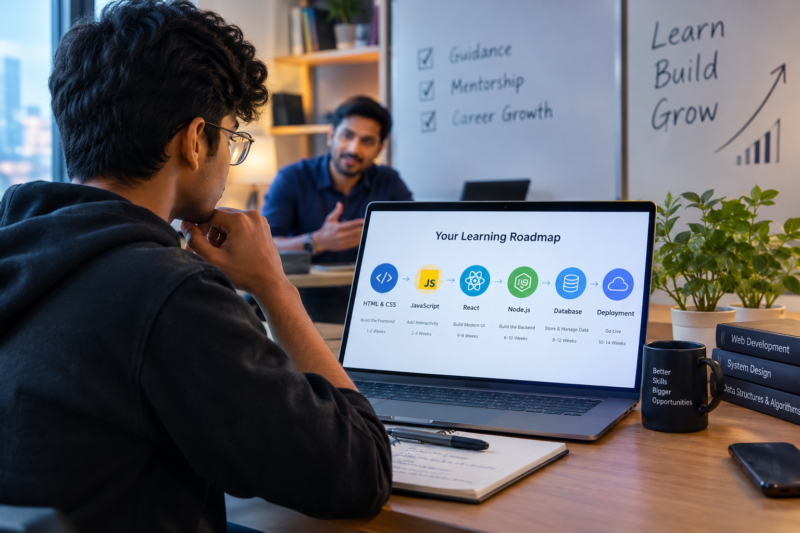
How Can Students Build a Focused Learning Roadmap?
A simple roadmap can begin with one career goal.
For example:
Step 1: Choose a Career Direction
Decide whether you are exploring software development, data, testing, cybersecurity, or another IT field.
Step 2: Select a Core Technology
Choose a suitable programming language or technical foundation.
Step 3: Learn the Fundamentals
Focus on concepts rather than memorizing syntax.
Step 4: Practice Regularly
Solve problems and apply concepts.
Step 5: Add Supporting Technologies
Learn technologies that complement your main skill.
Step 6: Review Your Progress
Finally, identify gaps and improve them.
Students seeking structured technical training can explore the programs and learning opportunities available through Floating Minds Institute.
What Does a Job-Ready IT Student Actually Look Like?
A job-ready student does not need to know everything.
Instead, they should be able to demonstrate:
- Strong technical fundamentals
- Practical problem-solving
- Ability to learn independently
- Clear understanding of their chosen technology
- Willingness to adapt
- Confidence explaining their work
Furthermore, they should understand that professional growth continues after getting the first job.
For broader information about changing technology and workplace skills, students can explore the World Economic Forum’s Future of Jobs research.
Final Thoughts: Why Floating Minds Institute Is the Right Choice
So, does an IT student need to know every programming language to build a successful career? No. What matters more is developing strong fundamentals, practical ability, and the confidence to keep learning. Floating Minds Institute focuses on structured technical education and practical career preparation, helping students understand technologies instead of simply collecting them. For learners who want focused training and a clear path toward IT careers, FMI can be a valuable choice when looking for the Best IT Training Institute in Hadapsar in 2026.