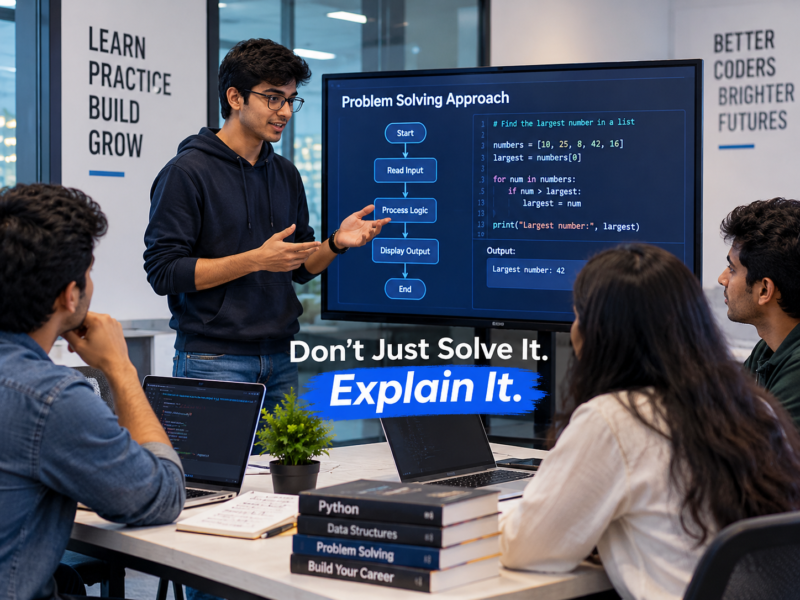
Introduction In IT, getting the correct answer is important. However, employers and technical teams often want to understand how you reached that answer. Two students may solve the same programming problem. One student can only show the final code. Meanwhile, another can clearly explain the problem, describe the approach, and discuss why they chose a particular solution. Therefore, the second student may appear more confident and prepared. Learning to explain technical thinking is becoming an important career skill. With practical guidance from the Best software Training Institute in Hadapsar, students can develop both technical knowledge and the ability to communicate their problem-solving process. Why the Final Answer Does Not Tell the Complete Story A correct answer shows that something worked. However, it does not always show whether the student understood the process. For example, a student may write working code after following an online tutorial. However, can they answer these questions? Therefore, students should learn to explain their thinking, not simply present a finished result. What Does “Explaining Your Thinking” Mean in IT? Explaining your thinking does not mean describing every thought in your mind. Instead, it means clearly communicating your professional approach. For example: Problem: The application is loading slowly. Observation: The database request takes too much time. Approach: Check the query and identify unnecessary data processing. Decision: Optimize the query before changing the application design. This approach makes technical communication clearer. Moreover, it helps others understand how a student or professional solves problems. How the Best software Training Institute in Hadapsar Can Build Technical Communication Skills Students can practice explaining their approach during regular learning activities. For example, after completing an assignment, a trainer can ask: What Problem Were You Solving? Students explain the original objective. What Approach Did You Choose? Students describe their method. Why Did You Choose It? Students explain the reason behind the decision. What Challenge Did You Face? Students discuss what went wrong and how they responded. Consequently, students begin connecting technical work with clear communication. Why This Skill Matters During Technical Interviews Technical interviews are not always about producing the fastest answer. Interviewers may also want to understand how candidates approach unfamiliar problems. Therefore, students should practice speaking while solving. For example, instead of silently working for several minutes, a candidate can explain: “First, I would understand the input. Then, I would consider a simple approach before checking whether a more efficient solution is needed.” This helps the interviewer understand the candidate’s approach. Moreover, it shows structured thinking. The “Pause, Plan, Explain” Method Students can use a simple three-step method. Pause Do not immediately jump into a solution. First, understand the problem. Plan Think about the possible approach. Identify the important steps. Explain Describe your approach clearly before or while implementing it. This method can improve both confidence and accuracy. Additionally, it helps students avoid rushing into unnecessary solutions. Why Explaining Decisions Builds Better Teamwork IT professionals regularly work with other people. A developer may need to explain a decision to a team leader. A tester may need to explain why something is a problem. A data analyst may need to explain findings to a business team. Therefore, technical knowledge alone is not enough. Professionals must also make their work understandable. The ability to explain decisions clearly can reduce confusion and improve collaboration. Practice With a “Why?” Question After completing any technical task, students can ask themselves: Why did I do it this way? This simple question can reveal whether they truly understand their work. For example: Why did I use this database query? Why did I choose this data structure? Why did I organize the application this way? If the student cannot answer, they may need to explore the topic further. As a result, learning becomes deeper and more intentional. Why Clear Thinking Leads to Better Problem-Solving When students explain their approach, they often discover weaknesses in their own logic. For example, while explaining a solution, they may realize that an important situation was not considered. Therefore, communication can actually improve technical thinking. Explaining an approach forces students to organize information. Moreover, it makes hidden assumptions easier to identify. This habit can lead to stronger and more reliable solutions. Students can also explore professional communication and technical learning resources through IBM SkillsBuild. How Students Can Practice This Skill Every Day Students do not need a formal presentation to improve. They can practice after completing a small task. Try this: Over time, students become more comfortable discussing technology. Students who want practical learning and career-focused skill development can explore the training opportunities available through Floating Minds Institute. Final Thoughts: Why Floating Minds Institute Is the Right Choice Successful IT professionals need more than the ability to produce correct answers. They also need to understand problems, make decisions, and communicate their approach clearly. Floating Minds Institute supports students through practical learning and career-focused development that encourages stronger technical understanding and confidence. By helping learners connect problem-solving with clear communication, FMI prepares students for interviews and professional environments. This practical approach makes FMI a valuable choice for students searching for the Best software Training Institute in Hadapsar and preparing for successful IT careers in 2026.
Why IT Students Should Learn to Read Technology Before They Learn to Build Everything in 2026
Introduction Most IT students are encouraged to build applications, write code, and create projects. These activities are important. However, there is another skill that often receives far less attention: learning how to read and understand existing technology. In real IT jobs, professionals do not always start from an empty screen. Instead, they often work with existing code, databases, documentation, systems, and applications created by other people. Therefore, students who learn how to understand existing work can become more confident and practical professionals. This is why training at the Best IT Training Institute in Hadapsar should help students develop not only the ability to create technology but also the ability to read, understand, and improve it. What Does It Mean to “Read” Technology? Reading technology means studying something that already exists and understanding how it works. For example, students may learn to: This skill is different from simply building something from scratch. Moreover, it teaches students how real technology is organized. Why Starting From Scratch Is Not Always the Real IT Experience Tutorial projects often begin with a blank file. Students receive instructions. Then, they build everything step by step. However, professional work can be very different. A new developer may join a company and receive access to thousands of lines of existing code. They may need to understand: Therefore, students should practice understanding existing systems before entering professional environments. How the Best IT Training Institute in Hadapsar Can Build This Important Skill Students can improve this ability through guided exercises. For example, instead of always asking students to build a new project, trainers can provide an existing application and ask questions. What Does This Code Do? Students must understand the logic before changing anything. Where Is the Problem? Students analyze the existing system to find an issue. What Would You Improve? Students suggest practical improvements. What Could Break? Students think about the possible impact of changes. Consequently, they develop a more realistic approach to technology. Why Reading Code Can Improve Coding Skills Many students believe they can improve only by writing more code. Writing is important. However, reading good code can also teach valuable lessons. Students can observe: Moreover, reading poorly written code can teach students what to avoid. Therefore, students should balance writing code with understanding existing code. Documentation Is Also a Technical Skill Technical documentation may not look exciting. However, professionals often depend on it. For example, when developers use a new tool or API, they need to understand: Students who know how to read documentation can learn independently. As a result, they become less dependent on tutorials. The MDN Web Docs provide a strong example of how developers can use official documentation to understand web technologies. Why Understanding Existing Systems Builds Better Confidence Students sometimes panic when they see a large project. They may think: “I don’t understand any of this.” However, large systems become easier when students learn how to break them into smaller parts. First, understand the overall purpose. Next, identify the main components. Then, study how those components connect. Finally, explore individual sections. This structured approach can make complex technology less intimidating. The “Explore Before Edit” Habit One valuable habit for every IT student is: Explore before you edit. Before changing code or a system, students should ask: This habit can prevent unnecessary mistakes. Furthermore, it teaches students to think before acting. That mindset is valuable in professional IT environments. How Students Can Practice Reading Technology Students can begin with simple exercises. Read a Small Project Download or open a small project and try to understand its structure. Explain the Flow Describe how information moves through the application. Read Documentation Choose a technology and explore its official documentation. Study One File at a Time Avoid trying to understand everything immediately. Make a Small Change After understanding the system, modify one small feature. Consequently, students gradually become comfortable working with unfamiliar technology. Why This Skill Can Make Students More Job-Ready Companies do not always need employees who can only create new things. They also need professionals who can understand, maintain, test, and improve existing systems. Therefore, students who develop this skill can become more adaptable. They learn how to enter unfamiliar environments and start asking useful questions. Students who want structured learning and practical exposure to real technology can explore the training programs available through Floating Minds Institute. Final Thoughts: Why Floating Minds Institute Is the Right Choice A successful IT professional must know how to build technology. However, they must also know how to understand technology that already exists. Floating Minds Institute supports practical learning by helping students develop strong technical foundations, problem-solving skills, and industry-focused thinking. By encouraging learners to explore, understand, and apply technology, FMI helps students prepare for more realistic professional challenges. This practical approach makes FMI a strong choice for students looking for the Best IT Training Institute in Hadapsar and preparing for successful IT careers in 2026.
Why IT Students Need a Personal Learning System to Stay Consistent in 2026
Introduction Many IT students know what they want to learn. However, they often struggle with a bigger challenge: staying consistent. One week, they study Python. The next week, they watch videos about artificial intelligence. Then, they switch to another technology without completing either learning path. As a result, students can spend months feeling busy without making meaningful progress. In 2026, success in IT requires more than motivation. Students need a simple system that helps them learn, practice, review, and improve consistently. This is where guidance from the Best software Training Institute in Hadapsar can help students turn scattered learning into a structured journey. What Is a Personal Learning System? A personal learning system is a repeatable process that helps students manage their learning. Instead of deciding every day what to study, students follow a simple structure. For example: Learn → Practice → Review → Apply → Repeat This approach reduces confusion. Moreover, students spend less time deciding what to do and more time actually learning. A personal learning system does not need to be complicated. It simply needs to work consistently. Why Motivation Alone Is Not Enough for IT Students Motivation can help students begin. However, motivation changes from day to day. Some days, students feel excited to learn. On other days, they may feel tired or distracted. Therefore, depending completely on motivation can create inconsistent progress. A system is different. For example, a student can decide: Consequently, learning continues even when motivation is low. Why the Best software Training Institute in Hadapsar Can Support Structured Learning Students often struggle because they do not know what to learn first. For example, they may start advanced topics before understanding the basics. This can create frustration. A structured training environment provides a clearer sequence. Students can learn one concept, practice it, and then move to the next level. Moreover, regular guidance can help students avoid unnecessary distractions. Therefore, structured learning can make progress easier to track. The Four Parts of an Effective Learning System A useful learning system can be built around four simple stages. 1. Learn One Clear Concept Start with a specific topic. For example: Avoid trying to learn too many unrelated concepts at once. 2. Practice Without Following Every Step After learning the concept, try using it independently. For example, write a small program without copying the tutorial. This step is important because understanding grows through practice. 3. Review What You Learned Return to important concepts regularly. However, reviewing does not mean watching the same video repeatedly. Instead, try to recall and explain the concept. 4. Apply It to Something Practical Finally, use the knowledge to solve a small problem. Consequently, learning becomes more useful and memorable. The “Minimum Progress” Rule Students often create unrealistic study plans. They may decide to study for five hours every day. However, after a few days, the plan becomes difficult to maintain. Instead, students can create a minimum progress rule. For example: Even on a busy day, I will spend at least 20 minutes learning or practicing. This small commitment helps maintain momentum. Moreover, students often continue studying once they begin. Therefore, consistency can be more valuable than occasional bursts of extreme effort. How Weekly Reviews Prevent Learning Confusion At the end of each week, students should take a few minutes to review their progress. They can ask: This simple review can prevent students from losing direction. Additionally, it helps them identify problems before they become bigger. Why Students Should Track Learning Output, Not Study Hours Studying for five hours does not automatically mean five hours of useful learning. Therefore, students should also track what they produced. For example: Instead of writing: Studied Python for two hours. Write: Created a Python program that reads and processes user input. This focuses attention on results. As a result, students can better understand whether their learning is becoming practical. How a Personal Learning System Builds Career Discipline The ability to learn independently is valuable throughout an IT career. Technology professionals regularly need to understand new tools and solve unfamiliar problems. Therefore, students who develop a strong learning system early gain an important long-term advantage. The IBM SkillsBuild learning platform also provides resources that support continuous skill development and career learning. Moreover, the habit of structured learning can help professionals remain adaptable as technology changes. Create Your Own Weekly IT Learning Routine Students can begin with a simple schedule. Monday to Thursday Learn and practice one focused topic. Friday Complete a small practical task. Saturday Review mistakes and difficult concepts. Sunday Plan the next week. This routine can be adjusted based on personal schedules. The important thing is not following a perfect timetable. Instead, the goal is creating a system that students can actually maintain. Students looking for structured technical education and practical learning can explore the career-focused programs available through Floating Minds Institute. Final Thoughts: Why Floating Minds Institute Is the Right Choice A successful IT career requires continuous learning, but students also need the right structure to stay focused and consistent. Floating Minds Institute supports learners through organized training, practical learning experiences, and career-focused guidance. By helping students follow a clear path instead of randomly jumping between technologies, FMI encourages smarter and more effective skill development. This structured approach makes FMI a strong choice for students searching for the Best software Training Institute in Hadapsar and preparing for long-term success in the changing IT industry.
Why IT Students Should Keep a Failure Log to Learn Faster in 2026
Introduction Most IT students try to hide their mistakes. A failed program, a broken query, or an unsuccessful project can feel frustrating. However, mistakes often contain valuable lessons. In 2026, students who learn how to study their failures can improve faster than students who simply move on after a problem is solved. Therefore, keeping a personal failure log can become a powerful learning habit. A failure log is a simple record of mistakes, technical problems, wrong approaches, and lessons learned. Instead of repeating the same errors, students can use their past experiences to become better problem-solvers. This practical mindset can be developed with guidance from the Best IT Training Institute in Hadapsar. What Is a Failure Log? A failure log is a personal record of things that did not work. For an IT student, it could include: However, the goal is not to collect negative experiences. Instead, the goal is to answer one important question: What did this mistake teach me? As a result, every failure becomes useful information. Why Forgetting Mistakes Can Slow Down Learning Students often solve a problem and immediately move forward. However, they may forget: Consequently, they can make the same mistake again later. A failure log helps prevent this. For example, after spending two hours fixing a coding issue, a student can write: Problem: Application was not connecting to the database. Cause: Incorrect configuration value. Lesson: Always check environment settings before changing the code. This small note can save significant time in the future. How the Best IT Training Institute in Hadapsar Can Encourage Learning From Mistakes A strong learning environment should not make students afraid of getting something wrong. Instead, students should understand that mistakes are a normal part of technical work. Programming, testing, data analysis, and system development all involve experimentation. Therefore, students need opportunities to try, fail, investigate, and improve. Moreover, trainers can help students understand the difference between repeating a mistake and learning from a mistake. The first slows progress. The second builds experience. The Four-Part Failure Log Method Students can keep their failure log simple. 1. What Was I Trying to Do? Clearly describe the original goal. For example: I was trying to connect my Python application to a database. 2. What Went Wrong? Explain the problem. The application returned a connection error. 3. What Did I Try? List the approaches you used. I checked the code, restarted the application, and reviewed the connection settings. 4. What Did I Learn? Write the most important lesson. Configuration problems can look like coding problems. Check settings first. Therefore, every technical problem becomes a reusable learning resource. Why Failure Logs Build Better Problem-Solvers Strong IT professionals do not always know the answer immediately. However, they know how to investigate. They look for patterns, test assumptions, read errors, and learn from previous experiences. A failure log supports this mindset. Over time, students can identify patterns such as: As a result, improvement becomes more targeted. From “I Failed” to “I Found Something That Doesn’t Work” Language can also change how students think about mistakes. Instead of saying: “I failed at this project.” Students can ask: “What part of my approach did not work?” This creates a more practical mindset. Moreover, it separates the student’s identity from the problem. A broken program does not mean the student is incapable. Instead, it means something in the current solution needs investigation. This is an important habit for long-term IT careers. Why Real IT Jobs Require Comfort With Mistakes Professional IT work involves unexpected problems. A deployment may fail. A system may slow down. A database may return incorrect results. A new update may create an unexpected issue. Therefore, professionals cannot panic every time something goes wrong. They need a structured approach. The ability to learn from problems, document solutions, and avoid repeating mistakes is valuable in almost every technical role. The Google Engineering Practices documentation also provides useful insights into structured engineering practices and continuous improvement. How Students Can Start a Failure Log Today Students do not need special software. They can use: The important part is consistency. After solving a difficult problem, spend two minutes recording: What happened? Why did it happen? What did I learn? Over time, this becomes a personal knowledge library. Turn Mistakes Into Your Personal Learning Database After several months, a failure log can become surprisingly valuable. Students may have dozens of real examples involving: Consequently, they create something unique: a database of their own learning experience. This knowledge can also improve interview preparation. When interviewers ask about challenges, students can discuss real situations and explain how they solved them. Students who want practical learning experiences and structured career development can explore the programs offered through Floating Minds Institute. Final Thoughts: Why Floating Minds Institute Is the Right Choice Learning technology is not about avoiding every mistake. Instead, it is about learning how to understand problems and improve after encountering them. Floating Minds Institute supports practical learning by helping students develop technical knowledge, problem-solving ability, and confidence through structured training. By encouraging learners to think, practice, and improve continuously, FMI helps students prepare for real IT challenges. This practical learning approach makes FMI a strong choice for students looking for the Best IT Training Institute in Hadapsar and aiming to build confident, long-term careers in the IT industry.
Why IT Students Need a Personal Skill Audit Every 90 Days in 2026
Introduction Many IT students spend months learning new technologies without stopping to ask an important question: Am I actually improving in the right direction? In 2026, the IT industry changes quickly. New tools appear, job requirements evolve, and employers expect practical abilities. Therefore, students should regularly review their progress instead of simply collecting more courses and certificates. A personal skill audit is a simple way to check what you know, what you can apply, and what you still need to improve. This habit can help students make smarter learning decisions. Moreover, guidance from the Best software Training Institute in Hadapsar can help learners identify important skill gaps and build a more focused career path. What Is a Personal Skill Audit? A personal skill audit is a regular review of your current abilities. Instead of asking only, “What should I learn next?”, students ask: Therefore, a skill audit helps students replace random learning with focused learning. Why Learning More Is Not Always the Same as Learning Better Students often believe that more courses automatically mean more knowledge. However, completing ten courses does not always mean a student can solve real problems. For example, a learner may complete courses in Python, SQL, and data analysis. Yet, they may still struggle to use these skills together. Therefore, students need to measure application, not just completion. A skill audit can reveal whether a student: As a result, students can focus their time where it matters most. The 90-Day Learning Review Method Students do not need to review their progress every day. Instead, a review every 90 days can provide a clear picture without becoming overwhelming. Month One: What Did You Learn? List the technologies, concepts, and tools you studied. However, do not stop at course names. Ask yourself whether you truly understand each topic. Month Two: What Can You Apply? Next, identify the skills you can use independently. For example, can you write a basic program without following a tutorial? Can you solve a problem using your knowledge? Can you explain why your solution works? Month Three: What Needs Improvement? Finally, identify the gaps. Perhaps you understand programming but need more debugging practice. Alternatively, you may know technical concepts but struggle to apply them to real situations. Consequently, your next learning plan becomes much clearer. Why the Best software Training Institute in Hadapsar Can Help Students Find Skill Gaps Students often find it difficult to judge their own abilities accurately. Sometimes, they feel confident because they completed a course. Meanwhile, they may underestimate skills they have already developed. Therefore, feedback from experienced trainers can be valuable. A structured learning environment can help students receive feedback on: Moreover, regular feedback helps students improve before small weaknesses become major gaps. Create a Simple Skill Scorecard Students can create a personal scorecard for every important skill. For each skill, use a simple rating: Level 1: I Have Heard About It You recognize the concept but cannot use it yet. Level 2: I Understand the Basics You understand the main concepts with guidance. Level 3: I Can Practice It You can complete basic tasks independently. Level 4: I Can Solve Problems With It You can apply the skill to practical situations. Level 5: I Can Explain and Improve It You understand the skill deeply enough to explain it and improve your work. This method makes progress visible. Furthermore, it helps students avoid pretending that every completed course equals mastery. Why Skill Gaps Can Be Good News Finding a weakness may sound negative. However, it can actually be useful. You cannot improve a problem that you refuse to identify. For example, discovering that you need better SQL skills gives you a clear direction. Similarly, realizing that your interview confidence needs work helps you focus your practice. Therefore, skill gaps should not create fear. Instead, they should create a learning plan. The World Economic Forum’s Future of Jobs Report highlights the importance of continuous skill development as job requirements continue to evolve. How a Skill Audit Prevents Random Learning Without a clear review system, students can easily jump from one trending technology to another. Today, they may start Python. Next week, they may move to AI. Then, they may begin cloud computing without completing either topic. This creates what can be called random learning momentum—students feel busy but may not make meaningful progress. A skill audit changes this. Before starting something new, students can ask: Does this skill support my career goal? If the answer is yes, they can continue. If not, they can avoid unnecessary distractions. The Best Questions to Ask During Your Skill Audit Every 90 days, students can answer these questions: These questions take little time. However, they can provide valuable direction. Turn Your Audit Into a 90-Day Action Plan A skill audit should lead to action. First, identify your biggest strength. Next, choose one or two important weaknesses to improve. Then, create realistic goals for the next 90 days. For example: Goal: Improve SQL skills. Action: Practice database queries three times each week. Proof: Complete one practical database task. Review: Check progress after 90 days. This approach makes learning measurable and focused. Students looking for structured IT learning and practical career guidance can explore the programs available at Floating Minds Institute. Final Thoughts: Why Floating Minds Institute Is the Right Choice A successful IT career is built through continuous improvement, not random learning. Students need to understand their strengths, identify skill gaps, and focus on the abilities that support their career goals. Floating Minds Institute helps learners build this direction through structured training, practical learning, and career-focused guidance. By encouraging students to develop relevant skills with a clear purpose, FMI supports smarter and more confident career preparation. This focused approach makes FMI a valuable choice for students searching for the Best software Training Institute in Hadapsar and preparing for long-term success in the IT industry.
Why IT Students Should Build a Digital Proof of Skills Before Applying for Jobs in 2026
Introduction In 2026, saying “I know Python” or “I have completed a course” may not be enough to impress employers. Recruiters increasingly want to see evidence of what a candidate can actually do. Therefore, IT students need a digital proof of skills that demonstrates their learning, practical ability, and problem-solving approach. A digital proof of skills can include projects, code repositories, technical explanations, certificates, case studies, and live demonstrations. Moreover, students who learn how to present their work clearly can stand out from candidates who only list skills on a resume. This is why choosing the Best IT Training Institute in Hadapsar can help students move beyond certificates and focus on demonstrating real capabilities. What Is a Digital Proof of Skills? A digital proof of skills is a collection of evidence that shows what you can do. Instead of simply claiming that you understand a technology, you demonstrate your knowledge through actual work. For example, a student learning web development can show: Similarly, a data science student can present datasets, analysis, dashboards, and project findings. As a result, employers can see practical evidence instead of relying only on statements in a resume. Why Certificates Alone Are Not Enough in 2026 Certificates can show that a student completed a course. However, they do not always show how well the student can apply the knowledge. For instance, two students may complete the same Python course. One student may only finish the lessons, while another may build three practical projects. Clearly, their level of practical readiness may be very different. Therefore, students should treat certificates as one part of their professional profile rather than the complete proof of their skills. Moreover, real projects can show creativity, consistency, technical understanding, and problem-solving ability. How the Best IT Training Institute in Hadapsar Can Help Students Build Real Proof Career-focused IT training should help students create something they can confidently show. Instead of completing lessons and moving immediately to the next topic, students should document their progress. For example, every major project can answer simple questions: What Problem Did You Solve? Explain the purpose of the project. Which Technologies Did You Use? Clearly list the relevant tools and technologies. What Challenges Did You Face? Show how you approached technical problems. What Was Your Contribution? Explain your individual role, especially in team projects. What Did You Learn? Share the key lessons gained from the experience. Consequently, a simple project becomes a stronger professional story. The “Show, Don’t Just Tell” Approach to IT Careers A resume tells employers about your skills. A digital proof of skills shows them. This difference can be powerful. For example, instead of writing: Skill: SQL A student can show: Created a database project that analyzed customer data and generated useful reports. Similarly, instead of simply listing: Skill: Python The student can demonstrate a working Python application. Therefore, students should start asking one important question: “What can I show to prove this skill?” This mindset can transform how they approach learning. Five Things Every IT Student Can Start Building Today Students do not need to wait until the final month before placements. Instead, they can start building their professional proof gradually. 1. A Project Collection Keep your best academic and personal projects in one organized place. 2. A GitHub Profile GitHub can help students document coding projects and development activity. The official GitHub documentation provides useful guidance for understanding repositories and collaboration. 3. Simple Project Explanations Write a short description explaining what each project does. 4. Problem-Solving Notes Document interesting technical problems and how you solved them. 5. A Professional Online Presence Keep your professional information organized and relevant to your career goals. Additionally, students should regularly update these materials as they learn new skills. Why This Concept Can Improve Interview Confidence Many students become nervous when interviewers ask: “Tell me about a project you worked on.” However, students with documented projects have something real to discuss. They can explain: As a result, interviews become less about memorized answers and more about genuine experience. Moreover, discussing real work helps students communicate more naturally. Building a Career Trail Instead of Starting From Zero One unique advantage of documenting skills is that students create a career trail over time. Every project becomes a milestone. Every solved problem becomes evidence of growth. Every new technology becomes part of a larger professional journey. Therefore, students should not think only about completing a course. Instead, they should think about what they are building throughout their learning journey. This approach encourages consistency. Furthermore, it gives students something valuable to improve and present when new opportunities appear. How Students Can Start With Their Next Project The process can be simple. First, choose one skill you are currently learning. Next, build a small practical project. Then, document the project clearly. After that, explain what you learned and what challenges you faced. Finally, improve the project over time. This creates a powerful cycle: Learn → Build → Document → Explain → Improve Students who want to combine structured learning with practical project development can explore the career-focused programs available at Floating Minds Institute. Final Thoughts: Why Floating Minds Institute Is the Right Choice In 2026, IT students need more than theoretical knowledge and certificates. They need real work they can confidently demonstrate. Floating Minds Institute focuses on helping students develop practical skills through hands-on learning, projects, and industry-relevant training. By encouraging learners to apply their knowledge and build meaningful work, FMI helps students prepare for real career opportunities. This practical approach makes FMI a strong choice for students looking for the Best IT Training Institute in Hadapsar and aiming to create a stronger professional identity before entering the IT industry.
How Learning by Teaching Can Make IT Students Better Professionals in 2026
Introduction Many IT students believe that learning means watching lectures, reading notes, and completing assignments. However, one of the most powerful ways to understand a topic is to explain it to someone else. When students teach a concept, they must organize their thoughts, identify gaps in their knowledge, and explain complex ideas in simple language. Therefore, learning by teaching can improve both technical understanding and confidence. This approach is especially valuable for students learning at the Best software Training Institute in Hadapsar, where practical learning and active participation can support stronger career preparation. Why Explaining a Concept Helps Students Understand It Better It is easy to feel confident after watching a tutorial. However, real understanding becomes clear when someone asks you to explain the topic. For example, a student may understand Python while following a lesson. Yet, explaining Python functions to another learner requires deeper thinking. Therefore, teaching forces students to: As a result, students often discover exactly what they understand and what they need to practice again. The “Teach It Simply” Method for IT Learning A useful learning habit is simple: learn something and then explain it in your own words. Students can follow this process: Step 1: Learn the Concept First, study a topic such as SQL joins, Python loops, cloud computing, or software testing. Step 2: Close the Notes Next, avoid looking at the original material. Step 3: Explain It Simply Then, explain the concept as if you were teaching a beginner. Step 4: Find the Gaps If you struggle to explain something, return to the topic and learn that part again. Step 5: Practice With an Example Finally, create a small project or practical example. Consequently, learning becomes active rather than passive. Why the Best software Training Institute in Hadapsar Can Encourage Peer Learning Students often learn differently from instructors and from one another. Therefore, peer learning can create a more interactive learning environment. For example, one student may explain a coding concept using an example that another student finds easier to understand. Moreover, group discussions encourage students to ask questions without hesitation. This can improve participation and confidence. A strong learning environment can encourage activities such as: As a result, students become active participants in their own learning. How Teaching Improves Technical Communication Skills Technical professionals must often explain complex ideas. For instance, a developer may need to explain an issue to a project manager. Similarly, a data analyst may need to explain results to a client. Therefore, students who regularly practice explaining technical concepts develop stronger communication skills. They learn how to: These skills become valuable during interviews and throughout an IT career. How Peer Learning Builds Confidence Before Interviews Technical interviews can feel stressful because students must explain their thinking while solving problems. However, students who regularly discuss and teach concepts become more comfortable speaking about technology. For example, instead of simply memorizing the definition of an API, they can explain: Consequently, their answers become clearer and more natural. The ability to explain knowledge is often just as important as having the knowledge itself. Why Questions Are an Important Part of Learning Teaching does not mean knowing everything. Instead, questions can make learning stronger. When another student asks a difficult question, the teacher may discover a new area to explore. Therefore, students should not fear saying, “Let me check that.” This habit encourages: Moreover, technology professionals constantly learn throughout their careers. The habit of asking questions remains valuable at every stage. Students can also explore guidance on building strong professional skills through resources such as IBM SkillsBuild. Turning Learning Into a Daily Habit Students do not need a classroom to practice learning by teaching. They can start with simple daily habits. For example: After learning a topic, explain it aloud for two minutes. Next, write a short explanation without copying from notes. Then, explain the topic to a friend or record a short video for yourself. Additionally, try answering one question about the topic without using AI or search engines. Over time, this process can significantly improve understanding and confidence. Combining Teaching With Real Project Practice Explaining theory is useful. However, practical experience makes learning stronger. For example, after teaching someone about databases, students should create a small database project. Similarly, after explaining APIs, they should build a simple application that uses one. Therefore, the strongest learning cycle is: Learn → Explain → Practice → Improve This approach helps students move beyond memorization. Students who want structured technical learning, practical exposure, and career-focused skill development can explore the learning opportunities available through Floating Minds Institute. Final Thoughts: Why Floating Minds Institute Is the Right Choice Successful IT learning requires more than simply completing a course. Students need to understand concepts, apply their knowledge, communicate clearly, and keep improving. Floating Minds Institute supports this kind of active learning through practical training, interactive sessions, and career-focused skill development. By encouraging students to build confidence alongside technical knowledge, FMI helps learners prepare for real professional challenges. This practical approach makes FMI a strong choice for students searching for the Best software Training Institute in Hadapsar and aiming to build successful IT careers in 2026.
Why Soft Skills Matter as Much as Technical Skills for IT Careers in 2026
Introduction In 2026, strong technical knowledge alone is not enough to build a successful IT career. Companies also look for professionals who can communicate clearly, work with teams, solve problems, and adapt to change. Therefore, students need to develop both technical and professional skills before entering the job market. This is where the Best IT Training Institute in Hadapsar can play an important role. A strong learning environment helps students build confidence, improve communication, and prepare for the real expectations of the workplace. Why Technical Skills Alone Are No Longer Enough Programming, testing, cloud computing, and data skills remain important. However, IT professionals rarely work alone. Most projects involve developers, testers, managers, designers, clients, and other stakeholders. Therefore, professionals must explain ideas clearly and work effectively with different people. Moreover, a technically skilled candidate may still struggle if they cannot communicate their ideas during an interview or collaborate with a team. As a result, soft skills have become an essential part of career readiness. Which Soft Skills Do IT Students Need Most in 2026? Students do not need to become perfect speakers overnight. Instead, they should gradually develop practical professional skills. Communication Skills Clear communication helps IT professionals explain technical ideas to both technical and non-technical people. For example, a developer may need to explain a system issue to a project manager. Therefore, the ability to communicate simply can save time and prevent misunderstandings. Teamwork Modern IT projects require collaboration. Students must learn how to share ideas, accept feedback, and support team goals. Moreover, teamwork helps professionals learn from others and solve problems faster. Problem-Solving Technical knowledge provides tools. However, problem-solving helps professionals decide how to use those tools. Consequently, students who can analyze challenges calmly often perform better in real work environments. Adaptability Technology changes quickly. Therefore, IT professionals must remain open to learning new tools and methods. Adaptability helps students stay relevant as industry requirements evolve. How the Best IT Training Institute in Hadapsar Can Build Student Confidence Confidence does not come only from reading books or watching tutorials. Instead, it develops through practice. Students can improve confidence by: Additionally, regular practice helps students become comfortable speaking about their work. As a result, they can perform better during interviews and professional meetings. Why Communication Skills Improve IT Interview Performance Many students prepare only for technical questions. However, interviews also test how candidates think and communicate. For example, an interviewer may ask a student to explain a project. A strong answer should clearly describe: Therefore, students who practice communication can present their technical knowledge more effectively. How Teamwork Prepares Students for Real IT Projects College assignments often focus on individual performance. However, professional IT environments are usually collaborative. Team projects teach students how to: Furthermore, teamwork helps students understand that successful projects require more than individual technical ability. For useful insights into workplace skills and career development, students can explore resources from the World Economic Forum. Why Soft Skills Support Long-Term Career Growth Technical tools may change over time. However, communication, teamwork, leadership, and problem-solving remain valuable throughout a career. For instance, a developer may later become a team leader. Similarly, a tester may move into project management. Therefore, students who build professional skills early are better prepared for future responsibilities. Moreover, strong soft skills help professionals build trust with colleagues and clients. How Students Can Start Improving Soft Skills Today Students can begin with small actions. First, explain one technical concept to a friend. Next, participate in a group project. Then, practice introducing yourself professionally. Additionally, students should ask for feedback and identify areas for improvement. Small improvements made consistently can create significant results over time. Students who want to combine technical learning with practical career preparation can explore the programs and learning opportunities available at Floating Minds Institute. Final Thoughts: Why Floating Minds Institute Is the Right Choice A successful IT career requires more than technical knowledge. Students also need confidence, communication skills, teamwork, and the ability to solve real problems. Floating Minds Institute supports students through practical learning and career-focused development that prepares them for professional environments. By combining industry-relevant technical education with practical exposure, FMI helps students become more confident and job-ready. This balanced approach makes FMI a valuable choice for students looking for the Best IT Training Institute in Hadapsar and preparing for successful IT careers in 2026.
How IT Students Can Use AI as a Learning Partner Instead of a Shortcut in 2026
Introduction Artificial intelligence is changing how students learn in 2026. Today, AI tools can explain concepts, generate examples, help with debugging, and support research. However, using AI without understanding the basics can create serious learning gaps. The smart approach is to use AI as a learning partner rather than a shortcut. Students who ask better questions, verify answers, and practice independently can learn faster and build stronger skills. Therefore, choosing the Best software Training Institute in Hadapsar can help students combine AI-powered learning with practical knowledge and real problem-solving. Why AI Should Support Learning Instead of Replacing Thinking AI can provide answers within seconds. However, getting an answer is not the same as understanding it. For example, a student can ask an AI tool to write code. Yet, if that student cannot explain the logic, fix an error, or modify the code, the learning remains incomplete. Therefore, students should first understand the problem. Then, they can use AI to explore different solutions. As a result, AI becomes a tool for deeper learning instead of a replacement for thinking. How AI Can Help IT Students Learn Faster When used correctly, AI can make learning more efficient. Moreover, it can provide personalized explanations based on a student’s questions. Students can use AI to: Additionally, students can ask AI to explain the same concept at different levels. For instance, they can request a beginner-friendly explanation before exploring advanced details. Consequently, learning becomes more flexible and interactive. Why the Best software Training Institute in Hadapsar Should Teach Responsible AI Learning AI is becoming part of modern workplaces. Therefore, students need to learn how to use it responsibly and effectively. A strong learning environment should teach students how to verify AI-generated information. Furthermore, students should understand when an answer requires independent research or practical testing. Instead of blindly copying AI-generated code, students should ask: Because of this approach, students develop stronger technical thinking. AI Can Improve Practice, but Practice Builds Real Skills AI can suggest solutions. However, practical work is still essential. For example, an AI tool may explain how to build an application. Nevertheless, students learn much more when they actually build it, encounter errors, and solve problems themselves. Similarly, AI can help identify possible bugs. Yet, students should still learn how to read error messages and investigate the root cause. Therefore, the best learning method combines: Learn the Concept First, understand the basic idea and purpose. Practice Independently Next, try solving problems without immediate assistance. Use AI for Guidance Then, use AI to compare approaches or understand mistakes. Test the Solution Finally, apply the learning to a real project. This process creates stronger and more independent IT professionals. Why Students Must Verify AI-Generated Answers AI tools can be helpful, but they can also produce incorrect or outdated information. Therefore, students should never assume every answer is automatically correct. Instead, they should verify important information through official documentation and trusted sources. For example, developers can use the official GitHub documentation to verify technical information and understand real development workflows. Moreover, learning to verify information builds an important professional habit. In IT careers, accuracy matters just as much as speed. How AI Changes the Skills IT Students Need in 2026 AI is automating some routine tasks. However, it is also increasing the value of human skills such as critical thinking, creativity, communication, and problem-solving. As a result, students should not focus only on getting faster answers. Instead, they should focus on asking better questions and understanding the results. The most valuable students will be those who can: Consequently, AI literacy is becoming an important part of career readiness. Building an AI-Ready Learning Strategy Students can start by creating a balanced learning routine. First, learn the fundamentals of a technology. Next, practice regularly without depending completely on AI. Then, use AI to explore difficult concepts and receive additional guidance. Moreover, students should work on real projects. This helps them understand how technology works outside tutorials. Students looking for practical, career-focused technology learning can also explore the training opportunities available through Floating Minds Institute. Overall, the goal should not be to compete against AI. Instead, students should learn how to work intelligently with it. Final Thoughts: Why Floating Minds Institute Is the Right Choice AI is creating new opportunities for IT students, but success still depends on strong fundamentals and practical thinking. Floating Minds Institute helps students develop industry-relevant skills through structured learning, hands-on practice, real projects, and career-focused guidance. By encouraging students to understand technology instead of simply copying answers, FMI supports smarter and more independent learning. This practical approach makes FMI a valuable choice for students searching for the Best software Training Institute in Hadapsar and preparing for the changing IT industry in 2026.
Why Audience Polling Helps IT Students Choose the Right Career Path in 2026
Introduction Choosing the right IT career can feel difficult for students in 2026. There are many options, including software development, data science, cloud computing, cybersecurity, testing, and artificial intelligence. Therefore, students need better ways to understand their interests before choosing a career path. This is where audience polling can make a real difference. Polls help students compare interests, discover popular career choices, and understand what others are exploring. Moreover, the Best IT Training Institute in Hadapsar can use interactive polls to guide students toward suitable learning paths based on their interests and career goals. What Is Audience Polling and Why Does It Matter? Audience polling is a simple way to collect opinions and preferences from a group of people. For IT students, polls can ask questions about their interests, favourite technologies, career goals, and preferred learning areas. For example, a poll could ask: As a result, students can start thinking seriously about their career preferences. How Polls Help Students Discover Their Real IT Interests Many students choose courses simply because their friends select them. However, every student has different strengths and interests. Interactive polls encourage students to think about what they actually enjoy. For example, someone interested in finding security issues may be better suited to cybersecurity. Meanwhile, a student who enjoys logic and building applications may prefer software development. Therefore, polling can become the first step toward better career awareness. Why the Best IT Training Institute in Hadapsar Should Understand Student Interests Good IT training is not only about teaching technology. Instead, it should also help students understand where their interests and strengths fit in the industry. By conducting polls through Instagram Stories, social media platforms, workshops, and student communities, an institute can understand what learners want to explore. Moreover, these insights can help create relevant discussions, workshops, and guidance sessions. Consequently, students receive a more engaging learning experience instead of generic career advice. Popular IT Career Poll Questions Students Can Answer Audience polls can make career exploration more interactive. For instance, IT students can vote on questions such as: Which IT Career Interests You Most? Which Skill Would You Like to Learn First? What Is Your Biggest Career Challenge? These questions can reveal common concerns among students. Furthermore, they can start useful conversations about career planning. How Polling Creates Better Career Awareness Students often hear about popular technologies without understanding what each career actually involves. However, polls can encourage them to explore different options. For example, if a student votes for cloud computing, the next step could be learning what cloud professionals actually do. Similarly, a student interested in data science can explore the skills required for that career. Therefore, polling can move students from simple curiosity toward informed career decisions. The World Economic Forum’s Future of Jobs research also highlights how changing technologies continue to reshape the skills needed in the workplace. Consequently, students need to stay aware of evolving career opportunities. How Interactive Polls Make IT Learning More Engaging Traditional career guidance can sometimes feel one-sided. Polls, however, allow students to participate. Instead of simply being told which career is best, students can share their preferences. Additionally, they can compare different fields and discover new opportunities. This creates several benefits: As a result, career exploration becomes more interactive and enjoyable. From Poll Results to a Clear Learning Roadmap A poll alone cannot choose a student’s career. However, it can provide an important starting point. After identifying their interests, students should explore: Therefore, the next step is turning interest into a structured learning plan. Students can explore IT courses and career-focused learning opportunities through Floating Minds Institute’s training programs. Why Career Choices Should Not Be Based Only on Popular Trends A technology may be popular today, but that does not automatically mean it is the right career for everyone. For example, one student may enjoy coding while another may prefer testing, analysis, or infrastructure. Therefore, students should consider their interests, strengths, and willingness to learn. Moreover, the best career path is usually one where personal interest meets valuable skills and real opportunities. Audience polling can help begin this process by encouraging students to ask an important question: What do I actually want to learn? Final Thoughts: Why Floating Minds Institute Is the Right Choice Choosing an IT career requires awareness, guidance, and practical learning. Floating Minds Institute helps students explore different technology paths while developing relevant skills for modern careers. Through interactive learning, career guidance, practical exposure, and industry-focused training, FMI helps students move from confusion to clarity. This student-focused approach makes FMI a strong choice for anyone looking for the Best IT Training Institute in Hadapsar and a clear path toward a successful IT career in 2026.