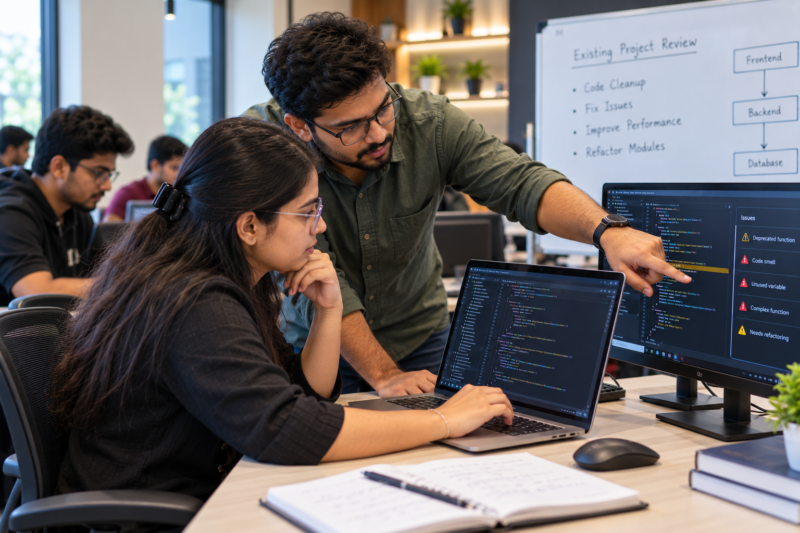
A student has an assignment due tomorrow.
The code almost works.
One small part is causing an error.
Instead of finding the real cause, the student adds a quick workaround.
The application works again.
Problem solved.
Or is it?
A few weeks later, another feature depends on the same code. The old workaround causes another problem. The student adds another fix.
Soon, the project becomes harder to understand.
This is a simple example of technical debt.
For IT students, learning how technical debt develops can be useful. Therefore, the Best IT Training Institute in Hadapsar should teach students not only how to make software work, but also how to keep it easier to maintain.
What Is Technical Debt?
Technical debt is a simple way of describing the future cost created by a shortcut in software development.
Think about cleaning your room.
You can put everything in the correct place.
Or, you can throw everything into one drawer because guests are arriving.
The second option is faster.
However, finding something later becomes harder.
Software can work in a similar way.
A quick coding decision may save time today.
However, it may create extra work later.
That future work is often called technical debt.
Why Do Developers Take Shortcuts?
Technical debt does not always happen because someone is careless.
There can be practical reasons.
Time Pressure
A feature may need to be completed quickly.
Limited Experience
A student may not yet know a cleaner way to solve a problem.
Changing Requirements
A project may change while development is already underway.
Temporary Fixes
A developer may plan to improve the code later.
However, “later” can easily become months or years.
As a result, temporary solutions sometimes become permanent parts of the software.
What Does Technical Debt Look Like?
Technical debt can appear in many forms.
Repeated Code
The same logic may be copied into several places.
If the logic changes later, every copy may need to be updated.
Hard-Coded Values
A value may be directly written into the code even though it could change later.
Complicated Functions
One function may try to do too many things.
This can make it difficult to understand or test.
Missing Tests
Code without useful tests can become harder to change safely.
Unclear Names
A variable or function with a confusing name can make future maintenance harder.
Temporary Workarounds
A quick fix may solve one problem while creating another.
None of these automatically means that the software is bad.
However, each can create extra work if left unmanaged.
Why Should IT Students Care About Technical Debt?
Students often think about completing a project.
That makes sense.
Assignments have deadlines.
However, software development does not end when the project first works.
Someone may need to change it later.
A new developer may need to understand it.
A customer may request another feature.
Therefore, students should also think about what happens after the first successful version.
For example, imagine a student creates a college management application.
The first version works.
Later, the student wants to add attendance reports.
If the original code is difficult to understand, adding that feature may take much longer.
As a result, the shortcut taken during the first version can affect future work.
Is Every Shortcut Bad?
No.
This is important.
Software development often involves trade-offs.
Sometimes a simple solution is enough.
A student does not need to build a highly complex system for a small classroom exercise.
The problem appears when a shortcut creates future work that nobody recognises.
Therefore, students should learn to ask:
Why am I taking this shortcut?
What problem could it create later?
Will someone need to change this code?
Should I record this as future work?
These questions can make shortcuts more deliberate.
How Can Students Spot Technical Debt?
Students can review their own projects with a simple checklist.
Is the Same Code Repeated?
If the answer is yes, consider whether it can be simplified.
Are Names Easy to Understand?
Someone else should be able to understand what a variable or function represents.
Are Functions Doing Too Much?
A function that handles many unrelated tasks may be difficult to maintain.
Are There Important Parts Without Tests?
If changing something could easily break another feature, testing becomes more useful.
Are There Temporary Fixes?
Look for comments such as:
“Fix later.”
“Temporary solution.”
“Need to improve.”
These comments can be useful reminders.
However, if they remain forever, the technical debt remains too.
Why Should the Best IT Training Institute in Hadapsar Teach Technical Debt?
Students can learn technical debt much better by seeing it in practice.
A trainer could give students a small project with deliberately messy code.
The application works.
However, some parts are repetitive and difficult to understand.
Students can first run the project.
Next, they can identify areas that may create future problems.
Then, they can improve one section without changing what the application does.
Finally, they can test it again.
This teaches an important lesson:
Improving code does not always mean adding new features.
Sometimes, improving the code means making existing work easier to maintain.
Can Technical Debt Exist in Student Projects?
Definitely.
Imagine a student needs to display the same calculation on five pages.
The student copies the calculation five times.
Everything works.
However, if the calculation changes, all five places must be updated.
That is a simple example of avoidable technical debt.
Another student may create one reusable function.
The first approach may feel faster.
The second approach may make future changes easier.
Therefore, students should start noticing these trade-offs early.
What Is Refactoring?
Refactoring means improving the internal structure of code without changing its intended behaviour.
For example, a student may have a very long function.
They can divide it into smaller functions with clear names.
The application should still produce the same result.
However, the code becomes easier to understand.
Similarly, repeated code can sometimes be moved into a reusable function.
As a result, future changes can become simpler.
How Can Students Practise Technical Debt?
Students can try a simple exercise.
Step 1: Build Something Quickly
Create a small application without worrying too much about perfection.
Step 2: Make It Work
Get the main feature running.
Step 3: Review the Code
Look for repetition, unclear names and complicated logic.
Step 4: Identify Three Problems
Do not try to fix everything.
Choose three areas that could cause future problems.
Step 5: Refactor One Area
Improve the structure while keeping the same behaviour.
Step 6: Test Again
Make sure the application still works.
This exercise teaches students to see software as something that evolves.
What Happens If Technical Debt Is Ignored?
Small problems can become harder to manage over time.
A repeated piece of code may appear in ten places.
A temporary workaround may become part of an important feature.
An unclear function may become connected to several other parts of the application.
Then, changing one small thing becomes difficult.
Therefore, technical debt can increase the effort needed for future development.
The important point is not to eliminate every piece of technical debt.
Instead, developers should understand it and manage it.
How Does This Help During a First IT Job?
Freshers may join projects that already contain technical debt.
They may see code that could be improved.
However, they should not immediately rewrite everything.
Instead, they can first understand why the existing code works the way it does.
Then, they can identify a specific problem.
After that, they can discuss the change with the team.
This approach is safer and more professional.
It also teaches students that software maintenance is part of development.
What Mistakes Should Students Avoid?
Trying to Make Everything Perfect
Perfection can slow down useful work.
Instead, focus on important improvements.
Rewriting Working Code Without Understanding It
Existing code may contain business rules that are not obvious.
Ignoring Future Changes
Think about whether the code will need to change later.
Creating “Temporary” Fixes Without Tracking Them
If a workaround is necessary, record what needs to be improved later.
Refactoring Without Testing
A cleaner-looking solution is not useful if it breaks existing features.
Therefore, testing should remain part of the process.
Why Does Technical Debt Matter in 2026?
Software changes constantly.
New features are added.
Old features are modified.
Teams change.
Customers ask for new requirements.
As a result, code that is easy to understand can make future work easier.
Students entering the industry should understand that their code may be maintained by someone else.
That changes how they should think about writing it.
The question is no longer only:
“Does my code work?”
It also becomes:
“Can another developer understand and safely change my code?”
How Can Practical Training Build This Mindset?
Students can revisit old projects instead of abandoning them after submission.
A trainer can ask them to open a project they completed several weeks earlier.
Then, students can try to understand their own code again.
They may discover that some parts are difficult to follow.
That experience can be valuable.
It shows students how future developers may feel when they encounter unclear code.
At Floating Minds Institute, practical IT training can help students develop the habit of thinking beyond the first working version and considering how software can be improved over time.
Final Thoughts: Make Code Work Today and Easier Tomorrow
Every developer takes shortcuts sometimes.
The goal is not to avoid every shortcut.
Instead, students should learn to recognise the cost of those decisions.
A quick fix may save an hour today but create several hours of work later.
Therefore, students searching for the Best IT Training Institute in Hadapsar should look for practical learning that teaches both development and maintenance.
Good software is not only software that works.
It is software that can be understood, tested and changed when the next requirement arrives.