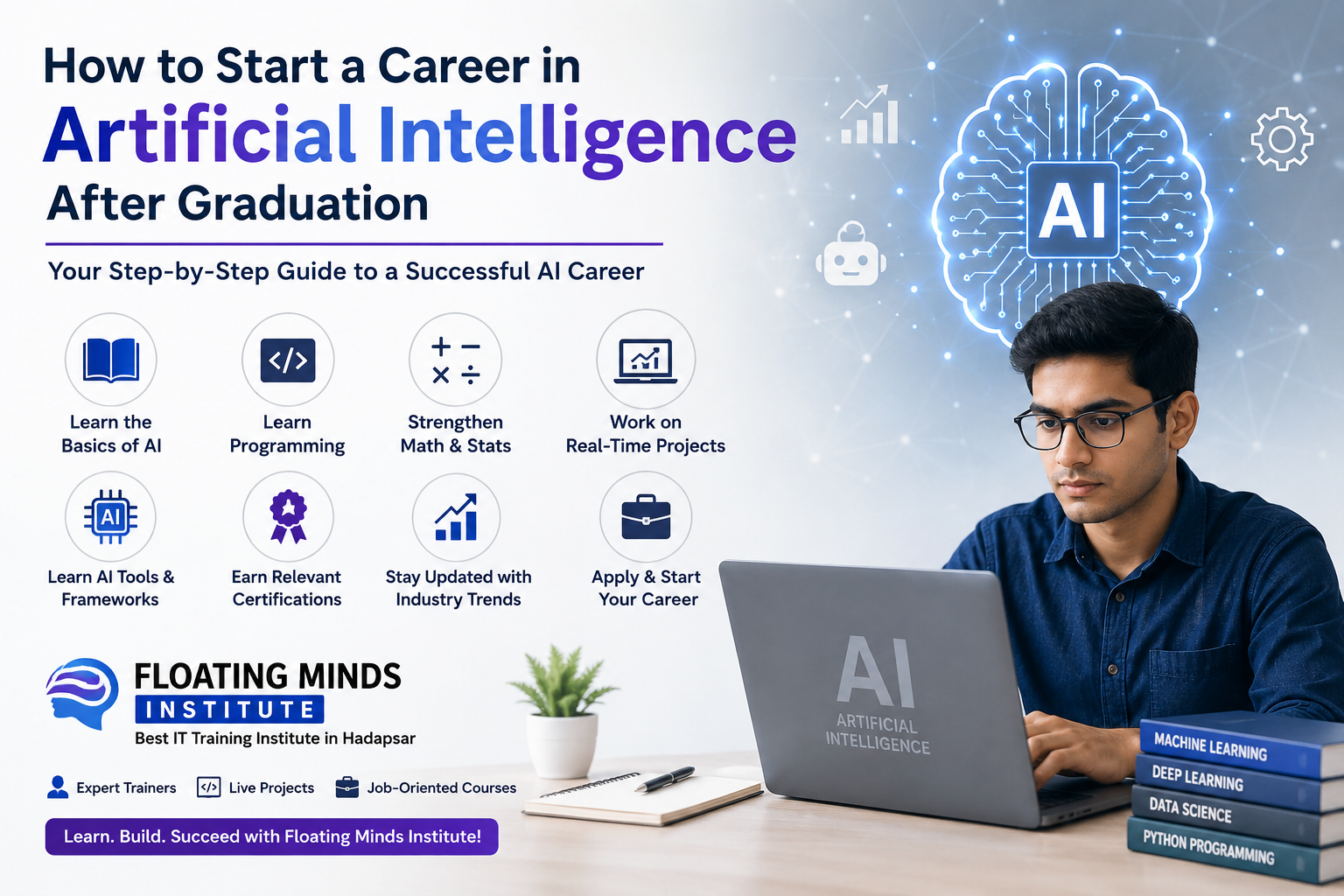
Artificial Intelligence (AI) is transforming industries worldwide, creating exciting career opportunities for graduates. From healthcare and finance to e-commerce and automation, companies are actively hiring AI professionals to develop intelligent solutions. If you have recently completed your graduation and want to enter one of the fastest-growing fields in technology, this guide will help you understand how to start a successful career in Artificial Intelligence.
Why Choose Artificial Intelligence as a Career?
Artificial Intelligence is one of the most in-demand technologies in 2026. Businesses are investing heavily in AI to improve efficiency, automate tasks, and make better business decisions. As a result, skilled AI professionals enjoy excellent job opportunities, competitive salaries, and long-term career growth.
Some benefits of choosing AI as a career include:
- High demand across industries
- Attractive salary packages
- Continuous learning opportunities
- Global career prospects
- Opportunities to work on innovative technologies
Step 1: Build Strong Programming Skills
The first step toward an AI career is learning programming. Python is the most widely used programming language for Artificial Intelligence because of its simplicity and powerful libraries.
You should also understand:
- Python Programming
- Object-Oriented Programming
- Data Structures
- Algorithms
- Basic Software Development Concepts
A strong programming foundation makes learning advanced AI concepts much easier.
Step 2: Learn Mathematics for AI
Artificial Intelligence relies on mathematical concepts to train intelligent systems.
Focus on learning:
- Linear Algebra
- Probability
- Statistics
- Calculus (Basic Concepts)
You do not need to become a mathematician, but understanding these concepts will help you work with AI models confidently.
Step 3: Understand Machine Learning
Machine Learning is the foundation of Artificial Intelligence. It enables computers to learn from data without being explicitly programmed.
Important Machine Learning topics include:
- Supervised Learning
- Unsupervised Learning
- Regression
- Classification
- Clustering
- Model Evaluation
Practical implementation is more important than theory.
Step 4: Learn Data Science Fundamentals
AI professionals work extensively with data.
Important skills include:
- Data Collection
- Data Cleaning
- Data Visualization
- Exploratory Data Analysis
- Feature Engineering
Tools like Pandas, NumPy, and Matplotlib are widely used for data analysis.
Step 5: Master AI Frameworks
Once you understand Machine Learning, start learning popular AI frameworks such as:
- TensorFlow
- PyTorch
- Scikit-learn
- Keras
These tools help developers build intelligent applications efficiently.
Step 6: Work on Real Projects
Employers prefer candidates with practical experience.
Build projects like:
- Chatbots
- Recommendation Systems
- Image Classification
- Face Detection
- Sentiment Analysis
- AI-Based Prediction Systems
Projects demonstrate your technical skills and improve your confidence during interviews.
Step 7: Learn Generative AI
Generative AI is one of the fastest-growing areas in technology.
Learn concepts like:
- Large Language Models (LLMs)
- Prompt Engineering
- AI Chatbots
- AI Automation
- Retrieval-Augmented Generation (RAG)
- AI Assistants
These skills are becoming highly valuable across industries.
Step 8: Build an Impressive Portfolio
Create a professional portfolio that includes:
- AI Projects
- GitHub Repository
- Resume
- Certifications
- Internship Experience
A strong portfolio often matters more than academic marks.
Career Opportunities in Artificial Intelligence
After completing your Artificial Intelligence training, you can apply for roles such as:
- Artificial Intelligence Engineer
- Machine Learning Engineer
- AI Developer
- Data Scientist
- NLP Engineer
- Computer Vision Engineer
- AI Research Associate
- Generative AI Developer
These roles are available in startups, multinational companies, healthcare, banking, e-commerce, manufacturing, and IT organizations.
Essential Skills for AI Professionals
To build a successful AI career, focus on developing:
- Programming Skills
- Analytical Thinking
- Problem-Solving Ability
- Machine Learning Knowledge
- Deep Learning Fundamentals
- Database Management
- Cloud Computing Basics
- Communication Skills
- Team Collaboration
Continuous learning is essential because AI technologies evolve rapidly.
Why Choose Floating Minds Institute?
If you are looking to build a successful career in Artificial Intelligence after graduation, Floating Minds Institute is one of the leading IT Training Institutes in Hadapsar, Pune. Our Artificial Intelligence Course in Hadapsar is designed to help students gain practical knowledge through hands-on training, live projects, industry-focused curriculum, and expert guidance.
Whether you are a graduate, fresher, or working professional, our AI training program equips you with the skills required to become job-ready. With experienced trainers, placement assistance, and real-world project experience, Floating Minds Institute helps students confidently launch their careers in the rapidly growing AI industry.
Conclusion
Artificial Intelligence offers endless opportunities for graduates who are ready to learn and adapt. By building strong programming skills, understanding Machine Learning, working on real projects, and mastering modern AI tools, you can establish a rewarding career in this rapidly expanding field. Choosing the right training institute and gaining practical experience will give you a competitive advantage in today’s technology-driven job market.
Start your Artificial Intelligence journey with Floating Minds Institute and prepare for a successful IT career in 2026.