Introduction
Many IT students spend months learning new technologies without stopping to ask an important question: Am I actually improving in the right direction?
In 2026, the IT industry changes quickly. New tools appear, job requirements evolve, and employers expect practical abilities. Therefore, students should regularly review their progress instead of simply collecting more courses and certificates.
A personal skill audit is a simple way to check what you know, what you can apply, and what you still need to improve. This habit can help students make smarter learning decisions. Moreover, guidance from the Best software Training Institute in Hadapsar can help learners identify important skill gaps and build a more focused career path.
What Is a Personal Skill Audit?
A personal skill audit is a regular review of your current abilities.
Instead of asking only, “What should I learn next?”, students ask:
- What skills have I already learned?
- Which skills can I use independently?
- Where do I still need help?
- What skills are required for my career goal?
- What should I improve during the next 90 days?
Therefore, a skill audit helps students replace random learning with focused learning.
Why Learning More Is Not Always the Same as Learning Better
Students often believe that more courses automatically mean more knowledge. However, completing ten courses does not always mean a student can solve real problems.
For example, a learner may complete courses in Python, SQL, and data analysis. Yet, they may still struggle to use these skills together.
Therefore, students need to measure application, not just completion.
A skill audit can reveal whether a student:
- Understands the basics
- Can work without step-by-step instructions
- Can solve practical problems
- Can explain their approach
- Needs more practice
As a result, students can focus their time where it matters most.
The 90-Day Learning Review Method
Students do not need to review their progress every day. Instead, a review every 90 days can provide a clear picture without becoming overwhelming.
Month One: What Did You Learn?
List the technologies, concepts, and tools you studied.
However, do not stop at course names.
Ask yourself whether you truly understand each topic.
Month Two: What Can You Apply?
Next, identify the skills you can use independently.
For example, can you write a basic program without following a tutorial?
Can you solve a problem using your knowledge?
Can you explain why your solution works?
Month Three: What Needs Improvement?
Finally, identify the gaps.
Perhaps you understand programming but need more debugging practice. Alternatively, you may know technical concepts but struggle to apply them to real situations.
Consequently, your next learning plan becomes much clearer.
Why the Best software Training Institute in Hadapsar Can Help Students Find Skill Gaps
Students often find it difficult to judge their own abilities accurately.
Sometimes, they feel confident because they completed a course. Meanwhile, they may underestimate skills they have already developed.
Therefore, feedback from experienced trainers can be valuable.
A structured learning environment can help students receive feedback on:
- Technical understanding
- Practical ability
- Problem-solving
- Communication
- Career readiness
Moreover, regular feedback helps students improve before small weaknesses become major gaps.
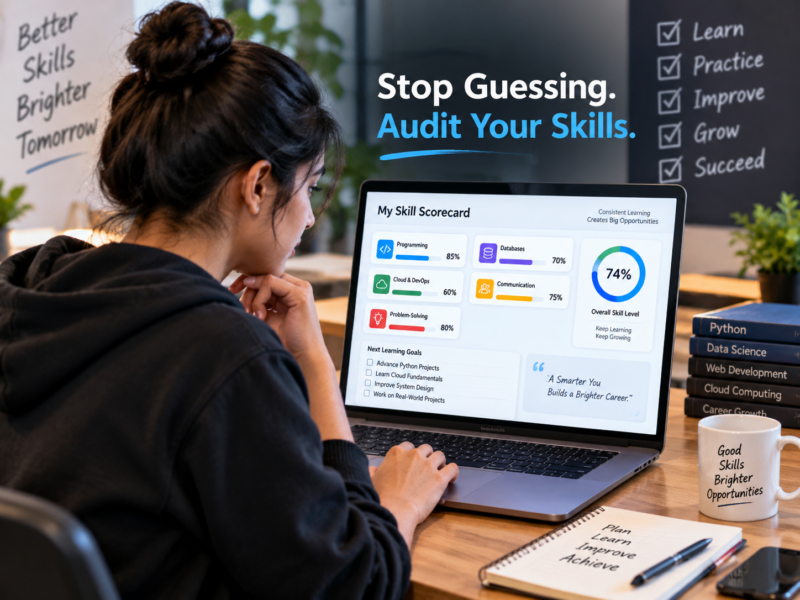
Create a Simple Skill Scorecard
Students can create a personal scorecard for every important skill.
For each skill, use a simple rating:
Level 1: I Have Heard About It
You recognize the concept but cannot use it yet.
Level 2: I Understand the Basics
You understand the main concepts with guidance.
Level 3: I Can Practice It
You can complete basic tasks independently.
Level 4: I Can Solve Problems With It
You can apply the skill to practical situations.
Level 5: I Can Explain and Improve It
You understand the skill deeply enough to explain it and improve your work.
This method makes progress visible.
Furthermore, it helps students avoid pretending that every completed course equals mastery.
Why Skill Gaps Can Be Good News
Finding a weakness may sound negative. However, it can actually be useful.
You cannot improve a problem that you refuse to identify.
For example, discovering that you need better SQL skills gives you a clear direction. Similarly, realizing that your interview confidence needs work helps you focus your practice.
Therefore, skill gaps should not create fear.
Instead, they should create a learning plan.
The World Economic Forum’s Future of Jobs Report highlights the importance of continuous skill development as job requirements continue to evolve.
How a Skill Audit Prevents Random Learning
Without a clear review system, students can easily jump from one trending technology to another.
Today, they may start Python.
Next week, they may move to AI.
Then, they may begin cloud computing without completing either topic.
This creates what can be called random learning momentum—students feel busy but may not make meaningful progress.
A skill audit changes this.
Before starting something new, students can ask:
Does this skill support my career goal?
If the answer is yes, they can continue.
If not, they can avoid unnecessary distractions.
The Best Questions to Ask During Your Skill Audit
Every 90 days, students can answer these questions:
- What did I learn during the last three months?
- Which skill am I most confident using?
- Which skill do I avoid because it feels difficult?
- Can I apply what I learned without a tutorial?
- What problem can I solve now that I could not solve before?
- Which skill is most important for my career goal?
- What should I focus on next?
These questions take little time. However, they can provide valuable direction.
Turn Your Audit Into a 90-Day Action Plan
A skill audit should lead to action.
First, identify your biggest strength.
Next, choose one or two important weaknesses to improve.
Then, create realistic goals for the next 90 days.
For example:
Goal: Improve SQL skills.
Action: Practice database queries three times each week.
Proof: Complete one practical database task.
Review: Check progress after 90 days.
This approach makes learning measurable and focused.
Students looking for structured IT learning and practical career guidance can explore the programs available at Floating Minds Institute.
Final Thoughts: Why Floating Minds Institute Is the Right Choice
A successful IT career is built through continuous improvement, not random learning. Students need to understand their strengths, identify skill gaps, and focus on the abilities that support their career goals. Floating Minds Institute helps learners build this direction through structured training, practical learning, and career-focused guidance. By encouraging students to develop relevant skills with a clear purpose, FMI supports smarter and more confident career preparation. This focused approach makes FMI a valuable choice for students searching for the Best software Training Institute in Hadapsar and preparing for long-term success in the IT industry.