Introduction
Most IT students try to hide their mistakes. A failed program, a broken query, or an unsuccessful project can feel frustrating. However, mistakes often contain valuable lessons.
In 2026, students who learn how to study their failures can improve faster than students who simply move on after a problem is solved. Therefore, keeping a personal failure log can become a powerful learning habit.
A failure log is a simple record of mistakes, technical problems, wrong approaches, and lessons learned. Instead of repeating the same errors, students can use their past experiences to become better problem-solvers. This practical mindset can be developed with guidance from the Best IT Training Institute in Hadapsar.
What Is a Failure Log?
A failure log is a personal record of things that did not work.
For an IT student, it could include:
- Coding errors
- Failed project attempts
- Wrong assumptions
- Database mistakes
- Debugging problems
- Interview questions answered incorrectly
- Concepts that were difficult to understand
However, the goal is not to collect negative experiences.
Instead, the goal is to answer one important question:
What did this mistake teach me?
As a result, every failure becomes useful information.
Why Forgetting Mistakes Can Slow Down Learning
Students often solve a problem and immediately move forward.
However, they may forget:
- What caused the problem
- Why their first approach failed
- How they eventually solved it
Consequently, they can make the same mistake again later.
A failure log helps prevent this.
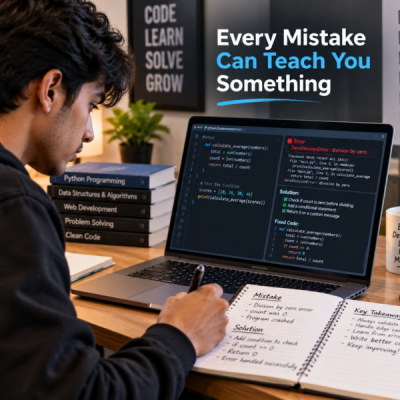
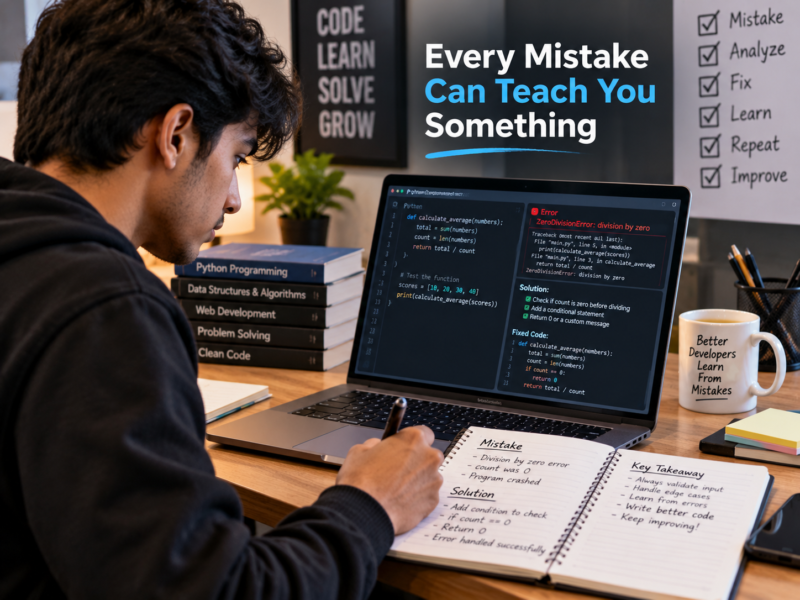
For example, after spending two hours fixing a coding issue, a student can write:
Problem: Application was not connecting to the database.
Cause: Incorrect configuration value.
Lesson: Always check environment settings before changing the code.
This small note can save significant time in the future.
How the Best IT Training Institute in Hadapsar Can Encourage Learning From Mistakes
A strong learning environment should not make students afraid of getting something wrong.
Instead, students should understand that mistakes are a normal part of technical work.
Programming, testing, data analysis, and system development all involve experimentation. Therefore, students need opportunities to try, fail, investigate, and improve.
Moreover, trainers can help students understand the difference between repeating a mistake and learning from a mistake.
The first slows progress.
The second builds experience.
The Four-Part Failure Log Method
Students can keep their failure log simple.
1. What Was I Trying to Do?
Clearly describe the original goal.
For example:
I was trying to connect my Python application to a database.
2. What Went Wrong?
Explain the problem.
The application returned a connection error.
3. What Did I Try?
List the approaches you used.
I checked the code, restarted the application, and reviewed the connection settings.
4. What Did I Learn?
Write the most important lesson.
Configuration problems can look like coding problems. Check settings first.
Therefore, every technical problem becomes a reusable learning resource.
Why Failure Logs Build Better Problem-Solvers
Strong IT professionals do not always know the answer immediately.
However, they know how to investigate.
They look for patterns, test assumptions, read errors, and learn from previous experiences.
A failure log supports this mindset.
Over time, students can identify patterns such as:
- The same type of coding mistake
- Common debugging errors
- Concepts they repeatedly misunderstand
- Areas where they need more practice
As a result, improvement becomes more targeted.
From “I Failed” to “I Found Something That Doesn’t Work”
Language can also change how students think about mistakes.
Instead of saying:
“I failed at this project.”
Students can ask:
“What part of my approach did not work?”
This creates a more practical mindset.
Moreover, it separates the student’s identity from the problem.
A broken program does not mean the student is incapable.
Instead, it means something in the current solution needs investigation.
This is an important habit for long-term IT careers.
Why Real IT Jobs Require Comfort With Mistakes
Professional IT work involves unexpected problems.
A deployment may fail.
A system may slow down.
A database may return incorrect results.
A new update may create an unexpected issue.
Therefore, professionals cannot panic every time something goes wrong.
They need a structured approach.
The ability to learn from problems, document solutions, and avoid repeating mistakes is valuable in almost every technical role.
The Google Engineering Practices documentation also provides useful insights into structured engineering practices and continuous improvement.
How Students Can Start a Failure Log Today
Students do not need special software.
They can use:
- A notebook
- Google Docs
- Notion
- A spreadsheet
- A simple text file
The important part is consistency.
After solving a difficult problem, spend two minutes recording:
What happened?
Why did it happen?
What did I learn?
Over time, this becomes a personal knowledge library.
Turn Mistakes Into Your Personal Learning Database
After several months, a failure log can become surprisingly valuable.
Students may have dozens of real examples involving:
- Programming mistakes
- Database problems
- Project challenges
- Technical misunderstandings
- Failed approaches
Consequently, they create something unique: a database of their own learning experience.
This knowledge can also improve interview preparation.
When interviewers ask about challenges, students can discuss real situations and explain how they solved them.
Students who want practical learning experiences and structured career development can explore the programs offered through Floating Minds Institute.
Final Thoughts: Why Floating Minds Institute Is the Right Choice
Learning technology is not about avoiding every mistake. Instead, it is about learning how to understand problems and improve after encountering them. Floating Minds Institute supports practical learning by helping students develop technical knowledge, problem-solving ability, and confidence through structured training. By encouraging learners to think, practice, and improve continuously, FMI helps students prepare for real IT challenges. This practical learning approach makes FMI a strong choice for students looking for the Best IT Training Institute in Hadapsar and aiming to build confident, long-term careers in the IT industry.