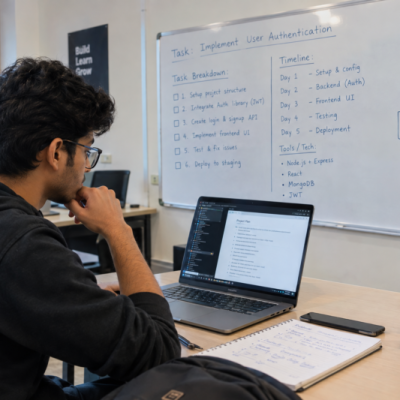
Imagine an IT student working on a difficult task.
The code is not working. The student tries one solution. Then another. After an hour, the problem is still there.
What should happen next?
Many students keep trying without asking anyone for help. They may feel that asking questions means they are not good enough.
However, the opposite can be true.
Knowing when to ask for help is an important workplace skill. Therefore, the Best software Training Institute in Hadapsar should help students learn how to ask useful technical questions instead of struggling alone for too long.
Why Do Students Hesitate to Ask for Help?
There are several common reasons.
Some students worry that their question is too basic. Others think they should solve every problem on their own.
Sometimes, students also fear what their classmates or teachers may think.
As a result, they may spend hours trying random solutions.
However, struggling for longer does not always mean learning more.
In some cases, one clear explanation can save hours of confusion.
Is Asking for Help a Weakness?
No.
In a professional IT team, developers regularly ask questions.
A developer may need to understand an old system. A tester may need clarification about a feature. A new employee may need help with an unfamiliar tool.
Therefore, asking for help is a normal part of technical work.
The important part is how the question is asked.
A weak question might be:
“My code is not working. What should I do?”
A better question could be:
“The login works with valid details, but the page gives an error when the password is incorrect. I checked the validation function, but I cannot find the issue. Could you help me understand what I should check next?”
The second question gives useful information.
As a result, another person can help much faster.
What Makes a Good Technical Question?
A good question gives enough context.
Students can follow a simple structure.
1. Explain the Goal
First, say what you are trying to achieve.
For example:
“I am trying to save customer details in the database.”
2. Explain What Happened
Next, describe the actual problem.
“The form submits, but the data is not being saved.”
3. Explain What You Tried
Then, mention the steps you already took.
“I checked the database connection and tested the form values.”
4. Share the Error
After that, provide the error message if there is one.
5. Ask a Specific Question
Finally, explain what you need help understanding.
This approach makes the conversation much easier.
Why Should the Best software Training Institute in Hadapsar Teach This?
Technical education often focuses on getting the correct answer.
However, real IT work involves many situations where the answer is not immediately known.
Students may need to investigate, discuss the problem and ask another person for guidance.
Therefore, training should give students opportunities to practise this process.
For example, a teacher can give students a difficult programming task and allow them to ask questions.
The goal should not be to avoid help.
Instead, students should learn to ask for help after making a genuine attempt and collecting useful information.
When Should an IT Student Ask for Help?
There is no fixed time limit.
However, some signs can tell students that it may be time to ask.
You Are Repeating the Same Attempts
If the same solution has failed several times, stop and review the approach.
Perhaps another perspective is needed.
You Do Not Understand the Error
An error message may point to a problem that the student does not understand.
In that case, asking someone can help the student learn what the error means.
You Are Guessing Instead of Testing
Random changes can make the problem harder to understand.
Instead, ask for guidance and test one idea at a time.
You Are Stuck on Something Fundamental
Sometimes the real problem is a missing concept.
For example, a student may struggle with an API because they do not understand how requests and responses work.
Therefore, asking for help can reveal the concept that needs more study.
Should Students Try First Before Asking?
Yes.
Asking for help does not mean avoiding independent thinking.
Before asking, students can try a few basic steps:
- Read the error message.
- Check the relevant documentation.
- Reproduce the problem.
- Test a smaller example.
- Review recent changes.
- Write down what has already been tried.
After that, the student can ask a much better question.
As a result, the answer is more likely to become a learning experience.
Can Asking Questions Improve Learning?
Definitely.
Suppose a student asks why a particular database query is failing.
The teacher explains the problem.
The student then understands not only the current error but also the idea behind it.
Next time, the student may recognise a similar problem independently.
Therefore, a good question can teach a concept that lasts beyond one assignment.
Moreover, students can keep a short list of questions they asked and the answers they received.
Over time, this can become a useful personal reference.
What Should Students Avoid When Asking for Help?
A few habits can make technical questions less useful.
Avoid Saying Only “It Doesn’t Work”
This gives almost no information.
Instead, explain what you expected and what actually happened.
Avoid Sending Huge Amounts of Code
The other person may struggle to find the relevant section.
Instead, share the smallest useful example.
Avoid Hiding What You Tried
Explain the steps you already took.
This prevents the same suggestions from being repeated.
Avoid Asking Without Trying
A quick attempt shows that you are engaged with the problem.
Therefore, make a reasonable effort before asking.
Can This Skill Help During a First IT Job?
Yes.
New employees often work with systems they have never seen before.
They may also use tools that were not part of their course.
In such situations, asking clear questions can help them learn faster.
For example, instead of spending half a day guessing how an internal system works, a new developer can ask a senior team member for the correct process.
However, the developer should first understand the basics and explain what they have already checked.
That makes the interaction more efficient.
How Can Students Practise This Skill?
Students can create a simple weekly exercise.
Whenever they face a technical problem, they should write five things:
What am I trying to do?
What happened instead?
What did I try?
What error or result did I get?
What exactly do I need to understand?
Before asking anyone, they can review these five points.
This habit takes only a few minutes.
However, it can make technical discussions much clearer.
Why Is This Skill More Important in 2026?
Modern developers have access to more information than ever.
They can use documentation, forums, online courses and AI tools to find answers.
However, more information does not always mean better understanding.
Students still need to decide what information they need and when another person’s experience can help.
AI can also provide possible answers, but students should still check those answers before using them.
Therefore, knowing how to ask precise questions remains valuable even when technology makes information easier to find.
How Can Practical Training Build This Habit?
A training environment can make questions part of the learning process.
For example, students can work on a technical problem and follow a simple rule:
Try → Investigate → Explain → Ask → Learn
First, they make an honest attempt. Next, they investigate the problem. Then, they explain what they found. After that, they ask a focused question.
Finally, they apply the answer.
This creates a healthy learning cycle.
At Floating Minds Institute, practical learning can help students connect technical knowledge with workplace habits that are useful beyond the classroom.
Final Thoughts: A Small Skill With a Big Workplace Benefit
IT students do not need to know everything before their first job.
Technology is too large for that.
Instead, they need to know how to learn when they do not know something.
That includes researching, testing, discussing problems and asking clear questions.
Therefore, students looking for the Best software Training Institute in Hadapsar can look beyond programming languages and course lists. They can also consider whether the learning environment helps them develop practical habits for real technical work.
After all, a good developer is not someone who knows every answer.
A good developer knows how to find the right answer.