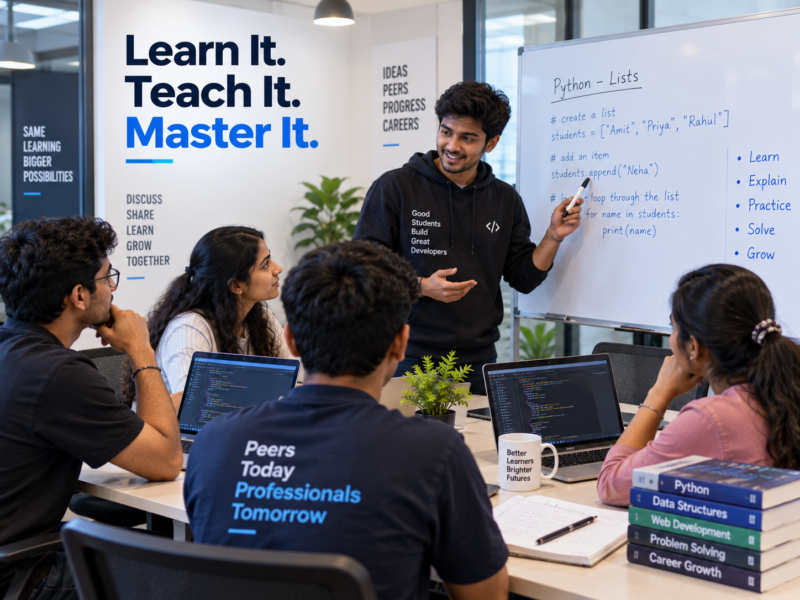
Introduction Many IT students believe that learning means watching lectures, reading notes, and completing assignments. However, one of the most powerful ways to understand a topic is to explain it to someone else. When students teach a concept, they must organize their thoughts, identify gaps in their knowledge, and explain complex ideas in simple language. Therefore, learning by teaching can improve both technical understanding and confidence. This approach is especially valuable for students learning at the Best software Training Institute in Hadapsar, where practical learning and active participation can support stronger career preparation. Why Explaining a Concept Helps Students Understand It Better It is easy to feel confident after watching a tutorial. However, real understanding becomes clear when someone asks you to explain the topic. For example, a student may understand Python while following a lesson. Yet, explaining Python functions to another learner requires deeper thinking. Therefore, teaching forces students to: As a result, students often discover exactly what they understand and what they need to practice again. The “Teach It Simply” Method for IT Learning A useful learning habit is simple: learn something and then explain it in your own words. Students can follow this process: Step 1: Learn the Concept First, study a topic such as SQL joins, Python loops, cloud computing, or software testing. Step 2: Close the Notes Next, avoid looking at the original material. Step 3: Explain It Simply Then, explain the concept as if you were teaching a beginner. Step 4: Find the Gaps If you struggle to explain something, return to the topic and learn that part again. Step 5: Practice With an Example Finally, create a small project or practical example. Consequently, learning becomes active rather than passive. Why the Best software Training Institute in Hadapsar Can Encourage Peer Learning Students often learn differently from instructors and from one another. Therefore, peer learning can create a more interactive learning environment. For example, one student may explain a coding concept using an example that another student finds easier to understand. Moreover, group discussions encourage students to ask questions without hesitation. This can improve participation and confidence. A strong learning environment can encourage activities such as: As a result, students become active participants in their own learning. How Teaching Improves Technical Communication Skills Technical professionals must often explain complex ideas. For instance, a developer may need to explain an issue to a project manager. Similarly, a data analyst may need to explain results to a client. Therefore, students who regularly practice explaining technical concepts develop stronger communication skills. They learn how to: These skills become valuable during interviews and throughout an IT career. How Peer Learning Builds Confidence Before Interviews Technical interviews can feel stressful because students must explain their thinking while solving problems. However, students who regularly discuss and teach concepts become more comfortable speaking about technology. For example, instead of simply memorizing the definition of an API, they can explain: Consequently, their answers become clearer and more natural. The ability to explain knowledge is often just as important as having the knowledge itself. Why Questions Are an Important Part of Learning Teaching does not mean knowing everything. Instead, questions can make learning stronger. When another student asks a difficult question, the teacher may discover a new area to explore. Therefore, students should not fear saying, “Let me check that.” This habit encourages: Moreover, technology professionals constantly learn throughout their careers. The habit of asking questions remains valuable at every stage. Students can also explore guidance on building strong professional skills through resources such as IBM SkillsBuild. Turning Learning Into a Daily Habit Students do not need a classroom to practice learning by teaching. They can start with simple daily habits. For example: After learning a topic, explain it aloud for two minutes. Next, write a short explanation without copying from notes. Then, explain the topic to a friend or record a short video for yourself. Additionally, try answering one question about the topic without using AI or search engines. Over time, this process can significantly improve understanding and confidence. Combining Teaching With Real Project Practice Explaining theory is useful. However, practical experience makes learning stronger. For example, after teaching someone about databases, students should create a small database project. Similarly, after explaining APIs, they should build a simple application that uses one. Therefore, the strongest learning cycle is: Learn → Explain → Practice → Improve This approach helps students move beyond memorization. Students who want structured technical learning, practical exposure, and career-focused skill development can explore the learning opportunities available through Floating Minds Institute. Final Thoughts: Why Floating Minds Institute Is the Right Choice Successful IT learning requires more than simply completing a course. Students need to understand concepts, apply their knowledge, communicate clearly, and keep improving. Floating Minds Institute supports this kind of active learning through practical training, interactive sessions, and career-focused skill development. By encouraging students to build confidence alongside technical knowledge, FMI helps learners prepare for real professional challenges. This practical approach makes FMI a strong choice for students searching for the Best software Training Institute in Hadapsar and aiming to build successful IT careers in 2026.
How Learning by Teaching Can Make IT Students Better Professionals in 2026
AI Training, Best IT Training Institute, Best Software Training Institute, Blog, career guidance, Data Analytics, Data Science', Digital Marketing, Floating Minds Institute, FMI, Full stack Java course, IT career roadmap, IT Courses with Live Projects, IT Training, IT Training Institute, Learning, Python course, Softaware Training institute, software testing course, Storybook