
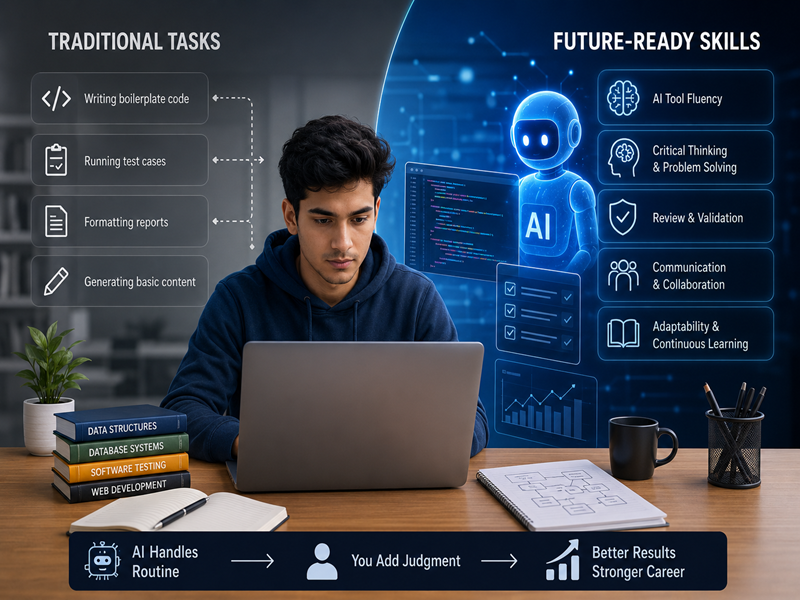
Starting a career in IT can feel exciting. However, many freshers have one common concern: Will AI reduce entry-level IT jobs? AI is changing the way companies work. Many tasks that once took hours can now be completed faster with AI tools. However, this does not mean that people are no longer needed. Instead, entry-level IT jobs are changing. Companies now expect freshers to use technology while also showing strong technical and problem-solving skills. So, what does this mean for someone starting an IT career? Let’s explore the changes and the skills you need to stay ready for the future. How AI Is Changing Entry-Level IT Jobs AI is already becoming part of many IT workflows. It helps professionals complete repetitive tasks faster. This change is especially noticeable in entry-level roles. 1. Routine Tasks Are Becoming Automated Many basic tasks can now be supported by AI tools. For example, AI can help with: As a result, freshers may spend less time on repetitive work. Instead, they may need to focus more on problem-solving and quality checks. 2. Companies Expect Faster Work AI tools can create a first draft within seconds. Therefore, companies may expect employees to complete routine tasks more efficiently. This does not mean working longer hours. It means learning how to use AI tools properly. A fresher who knows how to combine technical skills with AI tools can often work more efficiently. 3. Human Judgment Is More Important AI can generate useful results. However, it can also make mistakes. For example, AI-generated code may contain bugs. A test script may miss an important scenario. AI-generated content may also contain incorrect information. This is why human judgment still matters. Freshers need to check, test, and improve AI-generated work. 4. IT Roles Are Evolving AI is changing many IT roles. However, it does not automatically make those roles irrelevant. Software testing is a good example. AI can help automate repetitive testing tasks. However, testers still need to understand test cases, edge cases, and software quality. The same idea applies to development, data, and digital marketing. AI supports the work. People still need to make important decisions. Skills Freshers Need in the AI Era AI is changing the workplace. Therefore, freshers need to develop both technical and human skills. Here are some of the most important ones. 1. Strong Technical Fundamentals AI tools can generate code and provide answers. However, you still need to understand the basics. For example, a developer should understand programming logic. A tester should understand testing principles. A data professional should understand statistics and data concepts. Strong fundamentals help you identify mistakes. They also help you use AI more effectively. 2. AI Tool Skills You do not need to become an AI expert to use AI at work. However, you should understand how common AI tools can support your role. You can use AI for: The goal is not to depend on AI. The goal is to use AI as a useful assistant. 3. Critical Thinking Critical thinking is becoming more important. AI can provide an answer, but you still need to decide whether that answer is correct. Ask questions such as: These questions help you use AI responsibly. 4. Debugging and Problem-Solving AI can create a first version of code. However, that code may not always work. This is where debugging skills become valuable. A fresher who can find and fix problems has an important advantage. The same applies to testing and data roles. You need to understand problems before you can solve them. 5. Communication Skills Technical skills are important. However, communication also matters. IT professionals work with managers, developers, testers, clients, and other teams. You should be able to explain: Good communication can help you stand out during interviews and at work. 6. Adaptability and Continuous Learning Technology changes quickly. The tools you learn today may change in the future. New AI tools may also become part of your daily workflow. Therefore, freshers should develop a habit of continuous learning. You do not need to learn everything. Instead, focus on learning new skills that are relevant to your career. How AI Affects Different IT Career Paths AI is changing different IT fields in different ways. Full Stack Development AI coding tools can help developers write basic code faster. However, developers still need to understand application structure, databases, debugging, and security. Software Testing AI can support automated testing and repetitive test tasks. However, testers still need to design effective test cases and identify unusual situations. Digital Marketing AI can help create content, ideas, and ad copy. However, marketers still need to understand customers, campaign strategy, branding, and analytics. Data Science AI can speed up data cleaning and model development. However, professionals still need to understand data, interpret results, and explain insights clearly. What Should Freshers Do? If you are starting your IT career, there is no need to fear AI. Instead, learn how to work with it. Start by building strong fundamentals. Then, learn AI tools that are relevant to your chosen field. Most importantly, practice your skills through projects. Follow These Steps Step 1: Choose one IT career path Pick an area that matches your interests. You could choose development, testing, data, or digital marketing. Step 2: Learn the fundamentals Build a strong foundation before depending on AI tools. Step 3: Practice with AI tools Use AI to support your learning and projects. Step 4: Build real projects Projects help you apply your knowledge to practical problems. Step 5: Improve your communication Practice explaining your projects and technical decisions. Step 6: Keep learning Follow changes in your field and learn useful new tools. Common Mistakes to Avoid AI can make learning easier. However, using it incorrectly can slow your growth. Avoid these common mistakes: Depending Completely on AI Do not copy AI-generated answers without understanding them. Always review the output. Ignoring Fundamentals AI cannot replace your basic knowledge. Learn the concepts first. Then use AI to work faster. Avoiding Practical Projects Watching tutorials