
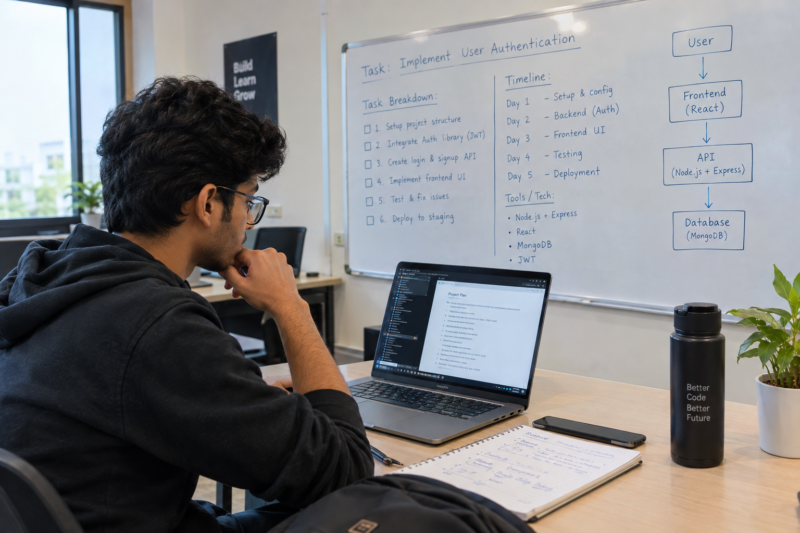
Have you ever started a coding task thinking it would take one hour, only to spend the whole day on it? This happens to many IT students. A task may look small at first. However, hidden problems can make it take much longer. In real software jobs, developers often need to estimate how much time a task may take. Therefore, students can benefit from learning this skill before their first job. The Best IT Training Institute in Hadapsar should help students understand not only how to complete a task, but also how to plan it. Why Do IT Students Often Underestimate Tasks? A student may look at a task and think, “This is easy.” For example, adding a search box to a website may sound like a quick job. However, the feature may also need: As a result, the actual work can be much larger than it first appears. Therefore, students should learn to look beyond the main feature. What Does Task Estimation Mean? Task estimation means making a reasonable guess about the work needed to complete something. It does not mean predicting the exact number of minutes. Instead, students learn to ask: What needs to be done? What could make it difficult? What information is missing? Have I done something similar before? How much testing will be needed? These questions make the estimate more realistic. Can the Best IT Training Institute in Hadapsar Teach Estimation? Yes. Students can learn estimation through simple classroom tasks. For example, a teacher could ask: “How long would you need to add a password reset feature?” A student might say: “Two hours.” However, the teacher can then ask what that estimate includes. Does it include the screen? Does it include email verification? Does it include security checks? What about testing? What happens if the email is not received? Suddenly, the student sees that the task has several smaller parts. Therefore, estimation can teach students to think about the complete task. Should Students Break Large Tasks Into Smaller Tasks? Absolutely. A large task is difficult to estimate. Smaller tasks are easier to understand. For example, instead of saying: “Build an online appointment system.” A student can break it into: Now each part can be considered separately. As a result, the final estimate becomes more useful. Why Should Students Add Time for Testing? One common mistake is estimating only the development work. However, software needs testing too. Suppose a student estimates that a form will take two hours to build. The form may work correctly in the first test. But what happens when: Therefore, testing should be considered before giving an estimate. A simple rule can help: Build time is not the same as total task time. Can Past Work Help Students Make Better Estimates? Yes. Students can keep track of how long common tasks actually take. For example, they may notice that: Over time, these observations create a useful reference. Moreover, students can compare their original estimate with the actual time. If a task was estimated at two hours but took five, they can ask why. Perhaps the requirements were unclear. Maybe the student was unfamiliar with the technology. In another case, testing may have taken longer. As a result, each completed task becomes a learning experience. What Should Students Do When They Do Not Know the Technology? This is another important part of estimation. Suppose a student receives a task involving a tool they have never used. Giving a confident estimate without checking the tool can be risky. Instead, the student can first spend some time learning the basics. For example: Step 1: Understand the requirement. Step 2: Check what technology is needed. Step 3: Identify what is already known. Step 4: Find the unknown parts. Step 5: Estimate the learning time. Step 6: Estimate the actual development work. Therefore, students learn that technical uncertainty should be part of planning. Can Estimation Help Students Avoid Last-Minute Work? Yes. Imagine a student has five tasks to finish in one week. Without an estimate, the student may start with the easiest task and leave the difficult work for the final day. However, a simple estimate can change the plan. For example: Task Estimated Time Login changes 2 hours Database update 3 hours Search feature 4 hours Testing 3 hours Documentation 2 hours Now the student can see the workload more clearly. Consequently, the student can plan the week instead of reacting to problems at the last minute. Does Estimation Mean Students Must Always Be Right? No. An estimate is not a promise. Unexpected problems can appear during development. Requirements can also change. Therefore, students should learn to update an estimate when new information becomes available. For example: Initial estimate: 3 hours New information: The existing database needs major changes. Updated estimate: 6 hours That is not necessarily a bad estimate. Instead, it shows that the student responded to new information. Can This Skill Help During Job Interviews? It can. Some interview questions focus on how candidates approach a task. An interviewer may ask: “How long would you take to build this feature?” Instead of giving a random number, a student can explain the factors behind the estimate. For example: “First, I would understand the requirements. Then, I would check the existing code, break the feature into smaller tasks and include time for testing.” This answer shows a process. Therefore, students can use estimation to demonstrate practical thinking. How Can IT Students Practise Task Estimation? The exercise is simple. Students can choose one small technical task each week. For example: Task: Add a contact form to a website. Before starting, write an estimate. Then complete the task. Afterward, record the actual time. Finally, compare the two. Ask: Over time, this creates better planning habits. Why Does Task Estimation Matter in 2026? IT work is becoming faster and more tool-driven. AI can now help developers create code, explain errors and complete routine tasks. However, faster coding does not remove the need for planning. In fact, when tools
Can IT Students Learn to Estimate a Task Before They Start Coding in 2026?
AI Training, Best IT Training Institute, Best Software Training Institute, Blog, career guidance, Data Analytics, Data Science', Digital Marketing, Floating Minds Institute, FMI, Full stack Java course, IT career roadmap, IT Courses with Live Projects, IT Training, IT Training Institute, Learning, Python course, Softaware Training institute, software testing course, Storybook