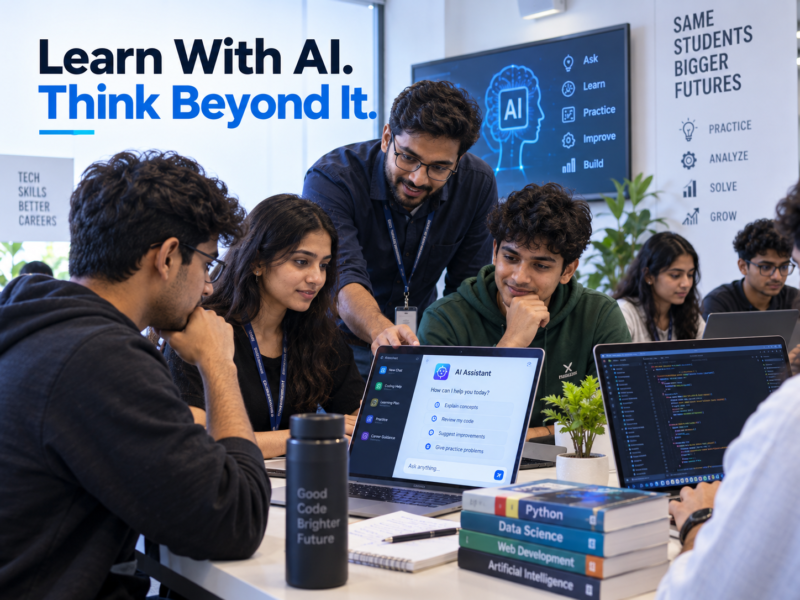
Introduction Artificial intelligence is changing how students learn in 2026. Today, AI tools can explain concepts, generate examples, help with debugging, and support research. However, using AI without understanding the basics can create serious learning gaps. The smart approach is to use AI as a learning partner rather than a shortcut. Students who ask better questions, verify answers, and practice independently can learn faster and build stronger skills. Therefore, choosing the Best software Training Institute in Hadapsar can help students combine AI-powered learning with practical knowledge and real problem-solving. Why AI Should Support Learning Instead of Replacing Thinking AI can provide answers within seconds. However, getting an answer is not the same as understanding it. For example, a student can ask an AI tool to write code. Yet, if that student cannot explain the logic, fix an error, or modify the code, the learning remains incomplete. Therefore, students should first understand the problem. Then, they can use AI to explore different solutions. As a result, AI becomes a tool for deeper learning instead of a replacement for thinking. How AI Can Help IT Students Learn Faster When used correctly, AI can make learning more efficient. Moreover, it can provide personalized explanations based on a student’s questions. Students can use AI to: Additionally, students can ask AI to explain the same concept at different levels. For instance, they can request a beginner-friendly explanation before exploring advanced details. Consequently, learning becomes more flexible and interactive. Why the Best software Training Institute in Hadapsar Should Teach Responsible AI Learning AI is becoming part of modern workplaces. Therefore, students need to learn how to use it responsibly and effectively. A strong learning environment should teach students how to verify AI-generated information. Furthermore, students should understand when an answer requires independent research or practical testing. Instead of blindly copying AI-generated code, students should ask: Because of this approach, students develop stronger technical thinking. AI Can Improve Practice, but Practice Builds Real Skills AI can suggest solutions. However, practical work is still essential. For example, an AI tool may explain how to build an application. Nevertheless, students learn much more when they actually build it, encounter errors, and solve problems themselves. Similarly, AI can help identify possible bugs. Yet, students should still learn how to read error messages and investigate the root cause. Therefore, the best learning method combines: Learn the Concept First, understand the basic idea and purpose. Practice Independently Next, try solving problems without immediate assistance. Use AI for Guidance Then, use AI to compare approaches or understand mistakes. Test the Solution Finally, apply the learning to a real project. This process creates stronger and more independent IT professionals. Why Students Must Verify AI-Generated Answers AI tools can be helpful, but they can also produce incorrect or outdated information. Therefore, students should never assume every answer is automatically correct. Instead, they should verify important information through official documentation and trusted sources. For example, developers can use the official GitHub documentation to verify technical information and understand real development workflows. Moreover, learning to verify information builds an important professional habit. In IT careers, accuracy matters just as much as speed. How AI Changes the Skills IT Students Need in 2026 AI is automating some routine tasks. However, it is also increasing the value of human skills such as critical thinking, creativity, communication, and problem-solving. As a result, students should not focus only on getting faster answers. Instead, they should focus on asking better questions and understanding the results. The most valuable students will be those who can: Consequently, AI literacy is becoming an important part of career readiness. Building an AI-Ready Learning Strategy Students can start by creating a balanced learning routine. First, learn the fundamentals of a technology. Next, practice regularly without depending completely on AI. Then, use AI to explore difficult concepts and receive additional guidance. Moreover, students should work on real projects. This helps them understand how technology works outside tutorials. Students looking for practical, career-focused technology learning can also explore the training opportunities available through Floating Minds Institute. Overall, the goal should not be to compete against AI. Instead, students should learn how to work intelligently with it. Final Thoughts: Why Floating Minds Institute Is the Right Choice AI is creating new opportunities for IT students, but success still depends on strong fundamentals and practical thinking. Floating Minds Institute helps students develop industry-relevant skills through structured learning, hands-on practice, real projects, and career-focused guidance. By encouraging students to understand technology instead of simply copying answers, FMI supports smarter and more independent learning. This practical approach makes FMI a valuable choice for students searching for the Best software Training Institute in Hadapsar and preparing for the changing IT industry in 2026.
How IT Students Can Use AI as a Learning Partner Instead of a Shortcut in 2026
AI Training, Best IT Training Institute, Best Software Training Institute, Blog, career guidance, Data Analytics, Data Science', Digital Marketing, Floating Minds Institute, FMI, Full stack Java course, IT career roadmap, IT Courses with Live Projects, IT Training, IT Training Institute, Learning, Python course, Softaware Training institute, software testing course, Storybook